Showing posts sorted by date for query Euproctis similis. Sort by relevance Show all posts

11 July 2018 - Beware the Dun-bar


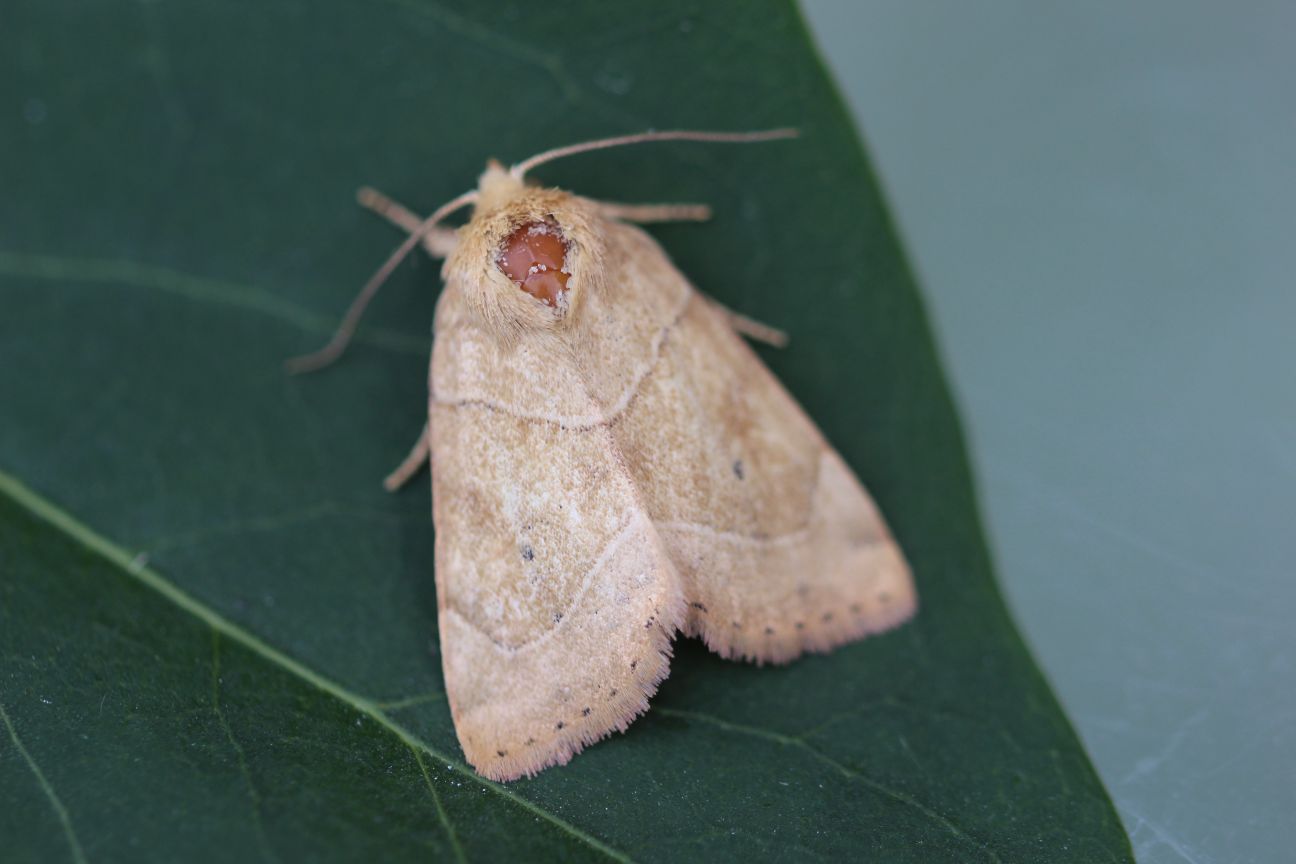
Dun-bar (Cosmia trapezina)

The weather has been treacherously, dangerously dry these past two weeks and if rain doesn’t come soon plants in the garden could be in serious trouble. The moths, however, have not yet seemed to notice the looming catastrophe and are still visiting the garden in considerable numbers.

Just like the Udea olivalis, the Dun-bar (Cosmia trapezina) is not new to the garden, but has yet to be featured on the blog. This is most likely because it is a common moth and no one thought to make it a headliner before now – but finally the Dun-bar will have its day! 
The one in the photograph is a little worn - that orange bald patch is normally covered over. 

This moth is an extremely variable species, with colors ranging from earthy-yellow to dark brown. In our trap we had a greenish individual, as well as an orangey rust colored one that was rather worn. Its name is quite literal: Cosima comes from the word “kosmios” meaning well-ordered, from the attractive appearance of the species in the genus; trapezina refers to the quadrilateral shape on its forewings. The Dun-bar usually sticks to a healthy, vegetarian diet of deciduous trees –however, the moth can turn freaky fast, being known to turn cannibalistic on the larvae of other moths and even its own when in captivity.

Dun-bar [illustration]

In this photo of a drawing from Humphreys and Westwood, we can see the little heads of some caterpillars peeking up underneath the Dun-bar – not the safest spot for them considering the Dun-bar’s dark proclivities. Watch out little caterpillars!

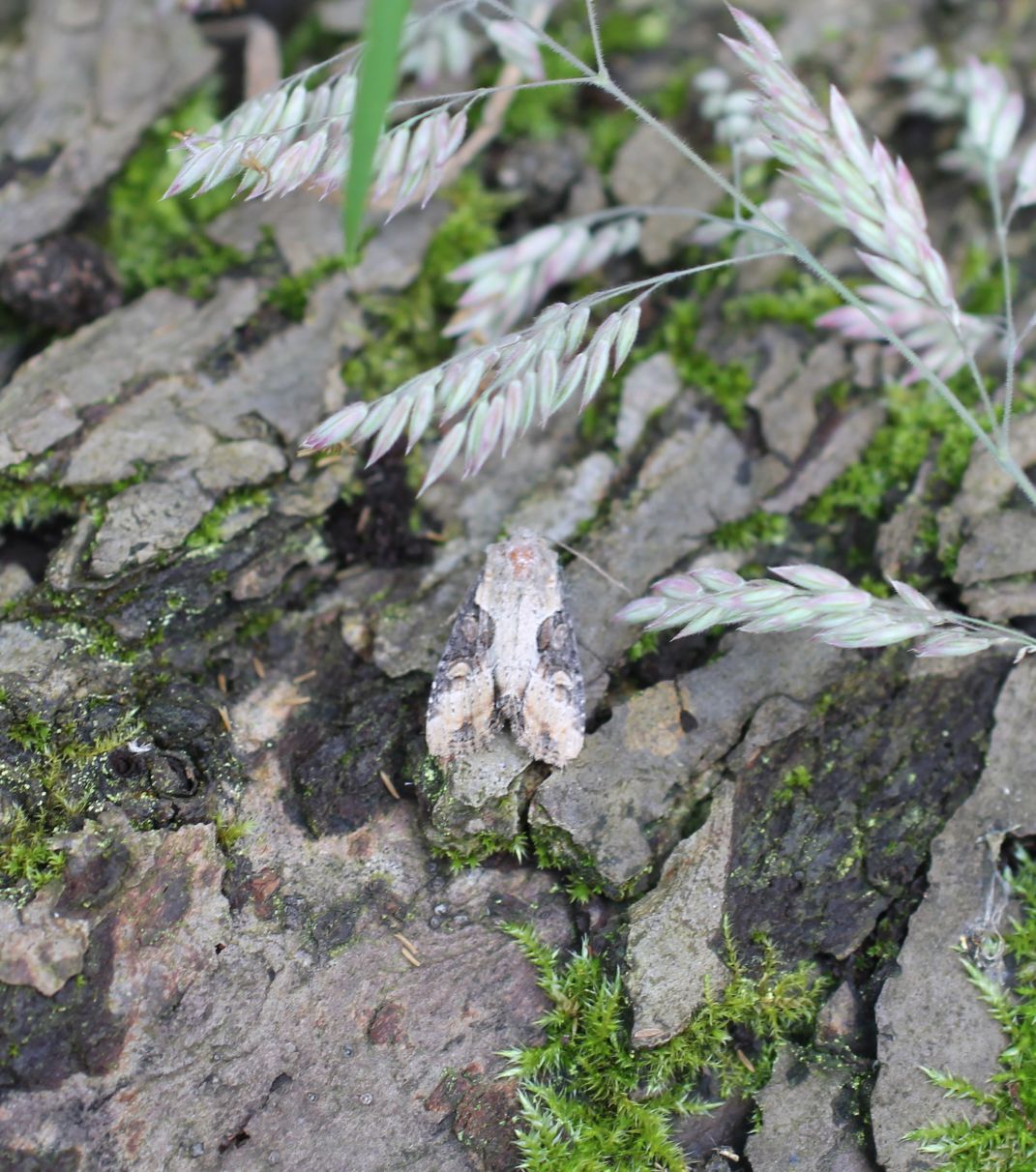
Common Rustic (Mesapamea secalis)

We also had either a Common Rustic (Mesapamea secalis) or a Lesser Common Rustic (Mesapamea didyma); the two can only be reliably identified through dissection –and you know our feelings on that. (It turns out to be a Common Rustic...on the best authority.)

Yellow Tail (Euproctis similia)

Finally, here’s a picture of a bright and bushy Yellow Tail (Euproctis similis). This moth has been featured on the blog plenty of times before, but I can’t resist this fluffy, funny-looking little creature. 


Post by: Gabriella Morace [UPenn intern]


7 July 2017 - Sipper of Dew


Yellow-tail (Euproctis similis)

Last night’s trap, in my opinion, was a success. While we did not increase the number of species to Shandy Hall, there were plenty which I have never seen before, including some interesting macro moths.

The Yellow-tail (Euproctis similis) was one of those. It was one of the first moths I noticed when looking into the trap as the light bouncing off its white body made it shine, almost like a beacon. The infamous yellow tail was not visible at first, but viewing the fluffy moth from a different angle exposed the golden abdomen. Its scientific name refers to its yellow tail, as Eu means ‘good’ and proctis means ‘backside’. The other half of the binomial similis means ‘similar’ because it resembles the Brown-tail (Euproctis chrysorrhoea) species. The larvae of the Yellow-tail feed on deciduous trees and shrubs.

The Drinker (Euthrix potataria)


As I was examining one of the egg boxes, looking closely for any micro moths, I looked underneath and there lay a peculiar shaped moth. This moth is called The Drinker (Euthrix potatoria), and it was resting in a spot previously occupied by an egg; the two don’t look too dissimilar either. I may go so far as to call it cute even, with its seemingly chubby body and pointed head. Its name Euthrix means ‘hair’, describing the hairy adult, and potatoria means ‘pertaining to drinking’, referring to the drinking habits of the larvae. 
Grasses and reeds make up the main diet for the caterpillars of The Drinker, but they also have an attraction to drops of dew, hence its name.

Double Lobed (Apamea ophiogramma)


The Double Lobed (Apamea ophiogramma), was another moth found in our trap from last night. It can be easily identified with its unmistakable pattern of two circular lobes, one on each wing. Apamea ophiogramma, meaning ‘snake marking’, makes reference to the meandering edge creating a partition between the two contrasting light and dark colors. The larvae feed on reed canary-grass (Phalaris arundinacea) and reed sweet-grass (Glycera maxima).  I need to confirm whether either of these plants are in the gardens here in Coxwold.

Along with these three species, we have also found Cryptoblabes bistriga, Clouded Silver, Common Emerald, Crambus lathoniellus, Green Arches, Elephant Hawk-moth, Muslin Footman, and Mottled Rustic, to name but a few.


Post : Walter Chen [UPenn intern]

29 June 2013 - Good Humour and Moths?

Everyone at Shandy Hall has been hustling and bustling about in preparation for the opening of the exhibition "The Good Humour Club" tomorrow. Patrick and I will be doing a moth trap tonight as well for anyone who might be interested in seeing a sample of Shandy Hall's moth species. We've been averaging around 70 moths a night for the past week so we hope we'll get a good selection for tomorrow. For more information about events happening at Shandy Hall, you can visit http://www.laurencesternetrust.org.uk/exhibitions-events.php. If anyone has any humourous moth jokes, or any good jokes really, we'd love to hear them @LSterneTrust.


Spruce Carpet (Thera britannica)
The Spruce Carpet (Thera britannica) is a new find for us and the only one of its kind that we've seen so far. The larvae feed on spruce and Douglas fir trees, hence the name Spruce Carpet. Oddly enough, we don't have any spruce or Douglas fir in the garden, though it may be possible that someone in town has one as a decorative piece. The Spruce Carpet's scientific name doesn't do much to describe it. Thera is an island in the Aegean Sea with no relation to the moth what-so-ever while britannica merely tells us that it is a member of the genus Thera that occurs in Britain. Our species list is now at 268.

Pupating Yellow-tail (Euproctis similis) Larva
On another note, one of our Yellow-tail caterpillars is pupating! This picture was taken about two days after it started to weave its cocoon. The other five caterpillars have gotten decently large as well. They will probably soon follow suit.

- Post by Jane Wu

11 June 2013 - Where are all the moths?

The moth trap numbers are going down again. Yesterday brought in a total of 13 moths, with two new ones included! Today though we caught a total of only two : a Poplar Hawk-moth and a Beautiful Golden Y. It is almost mid-June and the numbers still haven't started climbing. Where have all the moths gone?

Garden Carpet (Xanthorhoe fluctuata)
Our first new catch is a Garden Carpet (Xanthorhoe fluctuata). They are noted to be very common to Yorkshire, but this is the first time we have documented seeing one. This specimen looks to be very old. The dotted line that follows the bottom edge of the wing is barely visible from wear and tear. Xanthos 'yellow' and rhoe 'a stream' in Greek refer to the yellowish wavy lines on the wings of some of the members of the genus. The Garden Carpet comes in a multitude of color forms, most of which have wavy lines that are not yellowish. Fluctus in Latin means 'a wave.'

Small Square-spot (Diarsia rubi)
We caught two of the second new species, the Small Square-spot (Diarsia rubi). This identification has yet to be confirmed by Dr. Chesmore. One has more pronounced colors than the other. Its scientific name is strangely given, as there appear to be very few reasons for it. Diarsis means 'a raising up,' a guess possibly referring to how the male of some select specimens of the genus may raise their anal tufts, but there is not enough information to confirm that. Rubus, or 'the bramble genus,' is odd as well because the Small Square-spot actually feeds on a variety of plants and will rarely accept bramble.

In addition our caterpillars have really started coming along and are growing larger by the day. They've now grown to a size that we can identify them as Yellow-tail (Euproctis similis) caterpillars. Can you find all 6?

Yellow-tail (Euproctis similis) caterpillars

- Post by Jane Wu

7 October 2012 - Growing

Yellow-tail (Euproctis similis)?
The caterpillars continue to grow and their identity remains uncertain.  When the eggs were laid they were covered with hairs - which is a characteristic of the Lymantriidae family.  The hairs were brown, not yellow, but the larvae seem to look more like the Yellow-tail than the Brown-tail.  The orange colour is really very bright - especially the two protruding lumps next to the head.

 
This group photograph shows their discarded skins and the remaining eight or nine  larvae in various stages of development. 
This caterpillar news replaces a proper mothblog because there is so little to report.  Last night the temperature fell and the resulting globules of ice on the lawn give an indication as to how cold it was.  A Pink-barred Sallow, four Green-brindled Crescents, a Large Yellow Underwing and two Angle Shades - nothing more.  How will the bats fare?

25 July 2012 - Caterpillar News


Yellow-tail (Euproctis similis)

Yellow-tail from below
Today the Yellow-tail (Euproctis similis) arrived for the first time all year. It is not new to the Hall but I've never seen it before. It is white and fuzzy, much like yesterday’s White Satin Moth but with one main distinction. If it is disturbed, it sticks out its yellowish-orange abdomen from between its wings almost as an automatic reaction. Eu means ‘good’ and proktos means ‘anus’ or ‘backside’ because of its the protruding yellow tail.  Similis means ‘similar’ because of its resemblance to the Brown-tail species.

New eggs beside a Muslin Footman
There has also been another cluster of eggs found in the trap. We suspect that the nearby Muslin Footman is the mother, but we are not sure. We will be caring for them just as we did the group of eggs from earlier in the season.

This brings me to updates on the larvae. The caterpillars have been eating their clover, growing stronger and greener with each passing day. Take a look at the photograph, being sure to notice the eaten leaves, the frass, and the caterpillars themselves.

Larvae eating clover
-Post by Helen Levins

15 July 2011 - The 169th species

Acleris forsskaleana
Last night was a better night for moths – cloudy, warmish and not much in the way of a moon, or at least not over Coxwold. This morning at 6am there were four Garden Tiger moths, four Poplar Hawks, three Brimstones, Silver Ys, Broad-bordered Yellow Underwings, enough Common Footmen to staff a palace and  Muslin Footmen in abundance.  As a bonus there were some even more special: the significant 169th species to be identified at Shandy Hall, a Large Emerald (Geometra papilioneria), a Scalloped Oak (Crocalis elinguaria), an Acleris forsskaleana (new species), a Yellow-tail (Euproctis similis) and a Drinker (Euthrix potatoria).
Yellow-tail

Scalloped Oak
The Scalloped Oak takes its Latin name from the fact that it has no means of feeding as it is elinguis, speechless, without a tongue.  The crocalis refers to the moth’s yellow colour.  The Drinker is a favourite of mine.  The caterpillar likes to sample the morning dew (the Latin name means ‘hairy water drinker’) and when this moth is preparing for flight, its wings beat so furiously and with such intensity that, should you be carrying it on your finger, the vibrations are quite disconcerting.  A little powerhouse – and remarkably like a hedgehog in profile.

Drinker
The Large Emerald is gloriously green and sedate and unruffled.  Its resting position is so like that of a butterfly that it always seems about to flit away - but it doesn’t.  It just stays still all the day and waits for tonight’s release.

Large Emerald