Showing posts sorted by relevance for query Pheosia tremula. Sort by date Show all posts

14 May 2021 - Little Hope


Flame Shoulder (Ochropleura plecta)

Since the beginning of April the gardens at Shandy Hall have been victims of the weather.  Rain, hail, sleet, snow and very hard frosts have made attempts at moth trapping a thankless task. On the very few occasions the trap has been set, the result has been 'nothing to record'.  Surely this can't have been the same for the county - or even the country?  Laying out the white sheet, plugging in the mercury vapour lamp, making sure that collecting tubes are to hand along with a couple of small paint-brushes (in case some gentle coaxing is needed) and then finding the result is but only three moths can be discouraging.

The Flame Shoulder is a successful species and is resident and commonly found throught the UK.  In Yorkshire there are two generations and the larvae find food sources in gardens, farmland, grassland, hedgerows and wetlands.  The scientific name refers to the pale streak or 'twisted rope' (plecta) that is visible on the wing.


Swallow Prominent (Pheosia tremula)  
 

There is a Swallow Prominent (Pheosia tremula) and a Lesser Swallow Prominent (Pheosia gnoma).  They are easier to identify when one is compared directly against the other.  The white, wedge-like marking is cleaner on the Swallow Prominent's wing.  Leaves on the Silver Birch will sustain the caterpillar and the pupa overwinters underground. Pheosia means 'prickly plant' or 'spine' and tremula (shaking or trembling is also the scientific name of the aspen - 'willows whiten, aspens quiver' from Tennyson's The Lady of Shalott. Once this moth enters the trap it remains emphatically motionless until it is time to fly in the early evening.
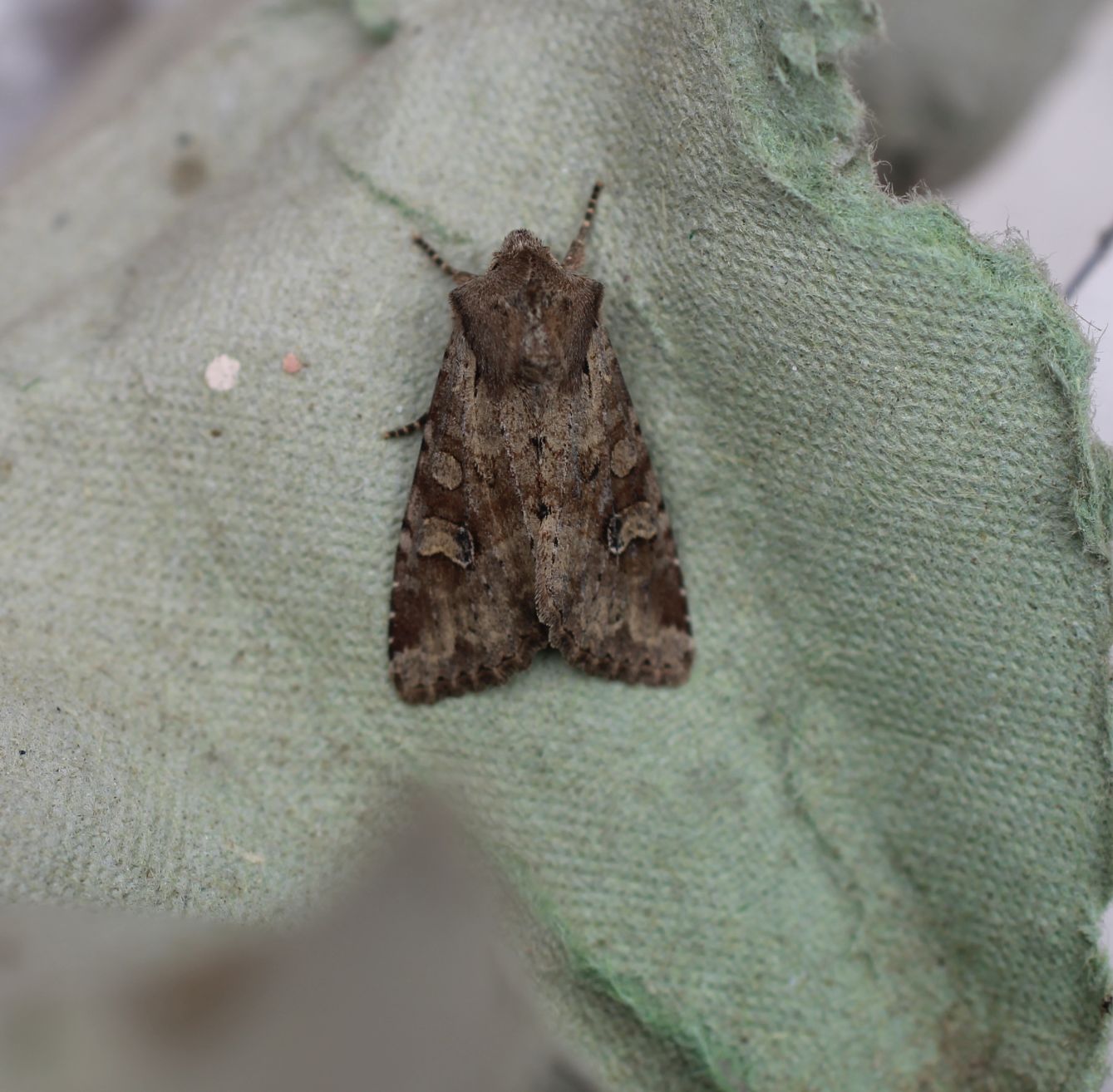
 

Rustic Shoulder Knot (Apamea sordens) 

Oh, the problems of the brown moths.  Looking over the previous photographs in this blog and pondering the possibilities in an attempt to identify this moth accurately, I am left with the Rustic Shoulder Knot (Apamea sordens) as the most likely candidate. The three little dots on the leading edge of the wing and the shape and positioning of the kidney mark seem strong indicators, but I confess this is by no means certain.  No doubt, should I be wrong, the error will be pointed out and an adjustment made.

Little hope for the weekend - more rain forecast - but an attempt will be made if possible. 

19 June 2012 - One with the Wood


Swallow Prominent, Pheosia tremula

This morning we had the Swallow Prominent (Pheosia tremula) resting on the frame of the screened cage. The color and pattern of its wings let it blend right into the wood. Pheosia, a prickly plant or spine, refers to these patterned lines running down its wings. Tremula means shaking or trembling and apparently describes the movement of the moth and its larva, although our Swallow Prominent was sound asleep in my presence so I can’t state whether I agree. If I had any say in it, I would insist that this moth be named for its vivid colors and symmetry that practically epitomize aesthetic beauty.

In other exciting news, we’ve gotten feedback on yesterday’s moths and we had in fact found another new species! The sandy-colored angular moth in the post is a Micro-moth, the Garden Pebble (Evergestis forficalis). Evergestis (well-wrought garment) describes the elaborate markings on the wings.  Forficalis, or scissors, is in reference to its angular posture.

Today's unidentified Wainscot, also blending into the wood*
Other moths that were confirmed from the weekend were a Small Angle Shades, a Middle-Barred Minor, and a Mottled Pug. I must also note, that today we also found a type of Wainscot, a Heart and Dart, White and Buff Ermines, a Beautiful Golden Y, another Notocelia Cynosbatella, and two common-looking species yet to be determined.

Because of the recent Micro-moths discoveries, we ordered a field guide of the Micro-moths. So far it has proved quite helpful, so we thought we’d share our source: It’s the Sterling, Parsons & Lewington Field Guide to the Micro Moths of Great Britain and Ireland. And just a heads up, British Wildlife is currently selling it at a reduced price.

Post by Helen Levins

*Shoulder-striped Wainscot (Mythimna comma) - Jane Wu

21 May 2017 - Be Prepared

(Coleophora -...)

Rain and wind make moth identification troublesome.  This metallic-winged micromoth was not only quite small but seemed keen to be on its travels.  I thought the photograph above would be sufficient for a positive identification and looking in the Lewington guide it seemed it must be one of four, metallic-winged moths.  Then I looked back through the blog to find that on 17 June 2016, Jane (with Charlie Fletcher's advice) had recorded a Coleophora maybella as a new species to the garden, identified by its stripey antennae (see below).

My latest photograph is not clear enough to be sure which of the Coleophora this one is. Does the fact that the antennae are not stripey (or are they at the tips?) mean that this is not identified but nonetheless new?
Had I taken a little more time, been properly prepared and recorded a clearer image, I would now be sure.


(Coleophora maybella)

The rest of Thursday night's trap contained familiar species but I needed to double check using the various websites and books that are guides to help the uncertain recorder.


Cinnabar (Tyria jacobaeae)

Easy to spot, the Cinnabar is very welcome, although there is no ragwort in the quarry.  The caterpillar (a bright, boldly striped yellow and black creature) is invariably seen on the flowering heads of the food plant.  There was one plant in the quarry a couple of years ago but for some reason it never appeared again - perhaps the victim of an over zealous horse-rider with a tendency to explode at the sight of Jacobaea vulgaris. The moth does fly during the day so it might have drifted in from the surrounding pasture. Only seen once before at Shandy Hall.

Muslin moths (Diaphora mendica)
A couple of male Muslin Moths.  The distinct grey of the male and the white of the female is recorded in the scientific name - diaphora means 'distinction'; mendica meaning 'beggar', referring to the mousy colour of the male; or it could also be associated with the Carmelite order where the friars wear white.  Take your pick.  Either way I haven't yet seen a female but they tend to fly during the day.  This could be a problem for the species but maybe dusk and dawn are their times of celebration.  Dock, plantain and red dead-nettle are food sources for the larvae - non of the latter here but plenty of dock and plantain.


Waved Umber (Menophra abruptaria)
The Waved Umber stays very still.  The stillness is accentuated by the pattern on the wings which form the shape of an abruptly ended series of crescent shapes, or 'eyebrow' (ophrus) of the 'moon' (mene).  Some moths seem to display moods and this could be an example of austerity.  The caterpillar feeds on the leaves of the shrub below - lilac - at the moment in full bloom.  Winter flowering Jasmine and privet are also suitable for the pupa to overwinter and hatch in the Spring as this one has done

Lilac (Syringa vulgaris)


Lesser Swallow Prominent (Pheosia gnoma)

The Lesser Swallow Prominent is high on the list of moths flying in May.  Relatively easy to identify, it can be confused with the slightly larger (but not always) Swallow Prominent (Pheosia tremula).  The Lesser will lay eggs on Silver Birch and Downy Birch trees, whilst the Swallow Prominent will choose willows and sallows.


Grey Dagger (Acronicta psi)

The Grey Dagger and the Dark Dagger are so alike that they are recorded as the same species, unless dissection is to take place.  The photograph was taken late in the evening while the rain was teeming down.  The deep black dagger markings embedded in the grey background are dramatic. 


Brown Silver-line (Petrophora chlorosata)

The last moth on this list is the Brown Silver-line, appearing as if ready to zoom off into the skies.


Brown Silver-line (Lozogramma petraria)

'Found wherever ferns grow' it says in British Moths and their Transformations (1845). This now reads as 'bracken' and it seems no alternative plants will suit the caterpillar.  I have unable to trace the meaning of the scientific name - although writing and stones seem to be part of it.
Other moths in the trap included Bright-line Brown-Eye, Brimstone, Small Magpie, Poplar Hawkmoth and Spectacle.  The weather seems promising so a trap on Thursday for the National Garden Scheme opening on Friday may produce a new species to the garden.