Showing posts sorted by relevance for query Perizoma flavofasciata. Sort by date Show all posts

17 May 2020 - Return

Poplar Hawkmoth (Laothoe populi)

Cold night after cold night made setting the moth trap a pointless exercise - nothing was to be found.  Apart from a group of Bee Moths (Aphomia sociella) emerging from a winter spent in a bee or wasp nest; and a Streamer (Anticlea derivata) sunning itself on a wall in early April, I have seen nothing else - although I do recall seeing a Silver Y zipping through the flowers on one of the warmer days of the month.

438 species have been recorded in the gardens at Shandy Hall - the last was on 22 May 2019 - and this selection from last night's trap is modest.  The Poplar Hawkmoth seems to do well in Coxwold and it is often found in the trap from May to early August.  No matter how often this moth appears its striking appearance does not diminish 


Sandy Carpet (Perizoma flavofasciata)
The Sandy Carpet (Perizoma flavofasciata) is probably attracted to the Red Campion in the quarry garden as it is the food plant for the larvae.  The scientific name refers to the yellow bands or girdles (perizoma) that decorate the fore-wings in a yellow colour (flavo).  Not found too often in overnight moth traps - it tends to fly in the early evening but rests overnight.  

Buff Ermine (Spilosoma luteum)
A regular visitor to the gardens, the Buff Ermine (Spilosoma luteum) is distinctive and easily identified.  The caterpillar feeds on nettles, honeysuckle and a wide range of other plants and then overwinters as a pupa to emerge in mid May.  The marking varies but often has a 'saddle' of black dots across the ridge of the resting wings. 

Purple Thorn (Selenea tetralunaria)
The scientific name of the Purple Thorn (Selenea tetralunaria) refers to the four 'lunar' spots to be seen on the wings of the adult - the shape of one can be clearly seen in the photograph.  The moth ends to remain static once in its daytime position, anchored to an egg-box on this occasion. The shape and attitude of the wings are balletic as if a perfect pose has been found and now needs to be displayed.  A moth of great beauty.

Rustic Shoulder-knot (Apamea sordens)
Is it a Rustic Shoulder-knot or is it not?  The photograph above shows a clearly marked example of a moth that one would assume is easy to identify.  What can be determined by the scientific name?  Apamea is the name of a town in Asia Minor where Theodore, one of the ancient Fathers of the Church, lived.  It is a name that has no entomological relevance.  The second part of the binomial sordens means 'dirty', which it isn't.  If the image is enlarged, three black lines (on the shoulders and where the wings join) can be seen which would fit.  If the website for Yorkshire Moths Flying Tonight is consulted it can be seen that the Rustic Shoulder-knot should be plentiful at this time - but this is an isolated example.  If I can't be certain then perhaps an email to Charlie Fletcher will reveal all... 


Flame Carpet (Xanthorhoe designata)
Beautifully marked and as fresh as a daisy, this Flame Carpet (Xanthorhow designata) has just emerged after overwintering as a pupa.  The food of the larva has not been established although (in captivity) the caterpillar will eat wallflowers and other plants of the cabbage family.

Green Carpet (Colostygia pectinataria)
And another carpet, but this time a green one.  Records show that this species arrived in Yorkshire in 1997 and is now common.  It's scientific name makes reference to the River Styx (Stygia), the black River of Hate in the Underworld which comes from the black lines (or rivulets) on the wings. Pectinataria refers to the comb-like antennae of the male.

Muslin Moth (Diaphora mendica
A very furry moth is the male Muslin Moth (Diaphora mendica) with wings that resemble the garb of a Carmelite mendicant friar - hence the scientific name.  The white female of this species, not the grey male, is the one that is being referred to.  Although the White Ermine (Spilosoma lubricipeda) comes to the garden as a common visitor, I have not yet been able to identify a female Muslin moth. 

Pale-shouldered Brocade (Lacanobia thalassina)
This first trap of the year closes with a Pale-shouldered Brocade (Lacanobia thalassina), another moth I have not found easy to identify.  It seems to be a question of 'getting your eye in' and a gap of nearly a year is quite a long time.  However, let us hope the weather is kind - warm sun, occasional refreshing rain, little wind and some luck and the number of species to identify and record may increase.  Sadly we have no intern from UPenn this year (you know why, of course) but hopefully the partnership will be restored in 2021.

10 June 2013 - New Moth Admirers at Coxwold Open Gardens.

Yesterday we had a good variety of catches, perfect for showing visitors during the Coxwold Open Gardens! Our Poplar Hawk-moth was by far the crowd favorite. The bright greenish-yellow Brimstone Moth and the two Scorched Wings were complimented on their colors, and our multitude of fluffy White Ermine slept peacefully in a bunch as their admirers watched. Also among the group was a newcomer to Shandy Hall, the Scalloped Hazel (Odontopera bidentata) and a moth we've seen, but haven't documented before, the Sandy Carpet (Perizoma flavofasciata).

Scalloped Hazel (Odontopera bidentata)
The Scalloped Hazel looks like it's trying to blend in with the cage bottom. For those who missed it yesterday, it was doing a very good job of hiding. Odous or odontos means in Greek 'a tooth' and peras 'the end.' Here they refer to the tooth-like edges on the Scalloped Hazel's wings. Bidens, in Latin 'having two teeth,' indicate two of the tooth-like curves on the wing that are bigger than the rest.

Sandy Carpet (Perizoma flavofasciata)
The Sandy Carpet, as with most carpets, was not inclined to stick around for long. It escaped earlier in the afternoon for those who didn't see it. Perizoma 'a girdle' refers to a band or bands of color on the wings resembling a belt. These may be more pronounced in other moths of the same genus. Flavus 'yellow' and fascia 'a band' describe the Sandy Carpet's characteristic yellowish belt.

Bucculatrix thoracella taking off
Bucculatrix thoracella
 With a change of position for our moth trap, we caught a new micromoth a few days ago, which has now been identified as Bucculatrix thoracella. Dr. Chesmore emailed me believing this identification is correct, though he would like to look for pupal cases later in the year on the large lime tree in the field opposite.  Bucculatrix is a relatively new species in Yorkshire and the cases, if found, will confirm its identity.  The moth is as eager and energetic as its colors might suppose, barely sitting still more than a second for me to take a photograph. Buccula refers to the large antennal eyecaps covering a good portion of the moth's head. Thorax or thoracis refers to the moth's yellow thorax, which is the same color as the wings. Along with the Scalloped Hazel, this brings our moth species count to 261.

For anyone interested in looking at some more moths up close, there is a special moth evening this coming Friday for National Gardens Scheme.  Dr. Chesmore will be here to identify moths and you can enjoy the gardens as the sun begins to set – if the rain holds off.

- Post by Jane Wu

22 July 2016 - Bulrush Nibbler

Limnaecia phragmitella

‘It’s an upside-down Flame!’ was my first reaction to this moth, though in truth the two are nothing alike. Swayed by the four apple-seed-looking dots in a line and the pale tip with evenly spaced black streaks, I went straight to the Gelechiidae family, but realized that none of their dots had the right configuration. Knowing I was missing the obvious, I took a break and saved myself from what the Chinese call ‘drilling into a bull’s horn’, or persisting blindly, often to a dead end.

A casual leaf through Lewington's guide minutes later revealed its identity: Limnaecia phragmitella although it is represented in the book as having more of an ashy color and less conspicuous markings. Ours is a peacock compared to that one.

‘Limnē’, marshy lake; ‘oikeō’, to dwell. The generic name outlines its zones of activity in the fens and marshes. Phragmites australis, its designated foodplant, is responsible for the species name, though the real foodplant is bulrush.


Small Yellow Wave (Hydrelia flammeolaria)

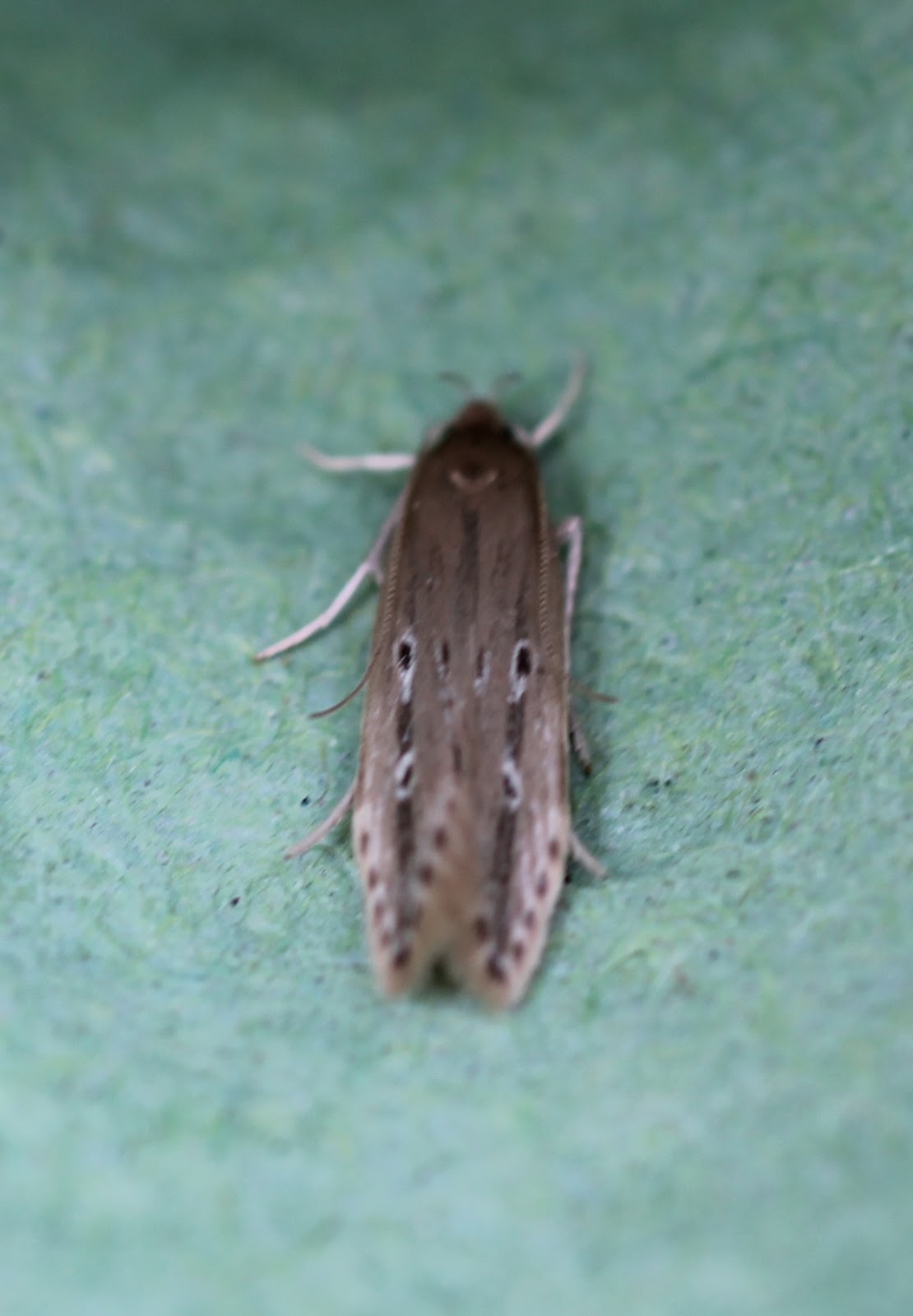
I have saved this magnificent Small Yellow Wave (Hydrelia flammeolaria) for last because the grand, fire-and-water spectacle is a good relief for the eye after squinting at micros for too long. Not many moths have this lasagne of white and yellow. The Sandy Carpet (Perizoma flavofasciata) is one, but it lacks the black dots and is much bigger. This moth is about the size of a Small Fan-footed Wave and rests in a similar position, with both pairs of wings showing. My only reservation was about the shape of the abdomen, but it may have been just a difference between eggs and no eggs.

The juxtaposition in its name can be broken down into hudrēlos, meaning watery, and flammeolus, flame-colored. The dripping gold is more apparent on the wings of a freshly hatched moth, but you can catch a glimpse of it in ours at the base of the wing where it meets the thorax.

Post: Tung Chau (UPenn)

21 January 2014 - Haiku by Maura Dooley

Sandy Carpet (Perizoma flavofasciata)


Sandy Carpet


A cockle-shell wing
opens like the memory
of a seaside town.

Maura Dooley