Showing posts sorted by relevance for query Noctua comes. Sort by date Show all posts

29 August 2020 - Moth Night 2020

Large Yellow Underwing (Noctua pronuba)
It didn't snow.  The wind lashed the acers and the rain caused the hollyhocks to lie flat, but it didn't snow so we have something to be grateful for.  Setting the trap on the first of the three evenings assigned as National Moth nights would have been pointless and last night was certainly a little better - apart from the temperature plummeting.  The result was a handful of moths this morning.  

The Large Yellow Underwing (Noctua pronuba) was one of the target species the organisers of the census had identified, along with any other examples from the same family.  Shandy Hall gardens have recorded a few varieties of Underwing but only four are regular : Broad-bordered Yellow Underwing (Noctua fimbriata), Lesser Yellow Underwing (Noctua comes), Lesser Broad-bordered Yellow Underwing (Noctua janthe), Copper Underwing (Amphipyra pyramidea), Lunar Underwing (Omphaloscelis lunosa) and Red Underwing (Catacala nupta) are the ones that have been seen and recorded - the links should connect to the earlier records on the blog.

Last week I would have predicted at least a hundred Large Yellow Underwings would be found in the trap - last night there were but nine.  

Lesser Broad-bordered Yellow Underwing (Noctua janthe)
 A second example of the same family is the Lesser Broad-bordered Yellow Underwing (Noctua janthe). The violet colour on the forewing is referred to in the scientific name noctua (by night); janthina (violet).  The caterpillar (which overwinters when half-grown) will feed on White Dead Nettle, Scentless Mayweed and Arum Lily amongst other shrubs and bushes.

Flame Shoulder (Ochroplura plecta)
A moth that is reliable with its markings and can't really be incorrectly identified.  The scientific name means 'the pale (or wan) twisted rope': a reference to the cream-coloured streak that runs down most of the edge of the forewing.  Plecta comes from pleura the Greek word for a rib.  The larvae will feed on Groundsel and bedstraws and the adults can be found in a wide range of habitat from wetland to moorland and woodland.

Sallow (Xanthia icteritia)
The only bright colour to cheer an otherwise totally brown collection of moths is the Sallow.  It is a very pretty moth that can be encouraged to become a resident in the garden with food available to the larvae in the form of sallow and poplar catkins and also docks.  The scientific name is extraordinary and is recorded on the blogpost: Myth Moth.

Silver Y (Autographa gamma)
The Silver Y (Autographa gamm) is a regular visitor and is common throughout the country.  It can often be seen in daylight feeding on cat-mint (nepeta) and valerian and is a speedy and purposeful flier.  The 'autograph' Y can be seen (upside down) on the forewing.

The cold wind was the reason the numbers were so low.  There were 6 Feathered Gothic Moths, a couple of Setaceous Hebrew Characters, a Lunar Underwing, a Flounced Rustic and one solitary micromoth that disappeared like a flash when the trap was opened.  

22 July 2014 - Where's the Yellow Underwing?

Least Yellow Underwing (Noctua interjecta)

Martin Handford's 'Where's Wally?' series of books for children has been one of my favourites while growing up.  In the book, the reader is asked to find the protagonist (Wally) dressed in a red and white sweater and light-blue jeans, in a setting filled with hundreds of other people.  The sheer number of characters in the illustrations can sometimes be a little overwhelming, but one (and only one of them) is special.

Yesterday I had to solve a 'Where's Wally?' puzzle of my own - in the moth trap.  The trap was packed with Yellow Underwings, including the Large Yellow Underwing (Noctua pronuba), the Lesser Yellow Underwing (Noctua comes), the Broad-bordered Yellow Underwing (Noctua fimbriata) and the Lesser Broad-bordered Yellow Underwing  (Noctua janthe).  I counted 130 Yellow Underwings in total.  However, only one was a newcomer to the garden.  It perched quietly under the clear plastic covering of the trap, its distinctive orange black-banded wings hidden from sight.  The new moth was a Least Yellow Underwing (Noctua interjecta caliginosa) adhering to the stringent hierarchy of the Noctua genus where  Noctua refers to the night, being also the name of the goddess Athena's owl. Interjecta means 'in between'; caliginosa means 'dark and obscure' - both words affirming the Least Yellow Underwings humble status in the family order being the most recently named, and smallest in size of the Yellow Underwings.

Post by Bowen Chang (UPenn)

28 September 2015 - Leamington Spa Moths


Nigel Hutchinson with moth trap
The weather forecast was not promising, although in early evening the sky was largely clear, a waxing moon rising. The moth trap looking like an alien spacecraft touched down on the lawn. An otherworldly cool glow filling the garden like stagelights for all-night performances. Overnight it rained more heavily than predicted, with a consequent drop in temperature. In the morning only nine moths and two crane flies in the trap.

Patrick unpacking with care and identifying most moths. I realised at this point how conditional identification is, are they old, are they worn? Puzzled too that not all micro-moths are as small as their name suggests. 


Lunar Underwing (Omphaloscelis lunosa)

The Underwing family well represented. The Large Yellow (Noctua pronuba) with its buttery surprise flashes of colour the commonest. Lesser Yellow Underwings (Noctua comes) too, convincingly camouflaged. They may be curious to us and worthy of study, but to other creatures they're just food! Subtle details of patterning identified the Lunar Underwing (Omphaloscelis lunosa). Intrigued by this, omphalos is the Greek word for 'navel'. Omphalos stones were the 'navel of the world' where contact could be made with the gods, such as at Delphi. Is this the origin of the moth's name? Why?

Silver Y (Autographa gamma)


Snout (Hypena probosciscidalis)

The Silver Y (Autographa gramma), the Snout (Hypena probosciscidalis) with a clearly visible 'nose' much finer than the name suggests and the 'does-what-it-says-on-the-tin', Light Brown Apple Moth, (Epiphyas postvittana), fittingly caught near a Bramley apple tree.

Light Brown Apple Moth (Epiphyas postvittana)

A Common Wainscot too, although its name (Mythimna palens) suggests a store of fables and more solid architectural detail.

Common Wainscot (Mythimna palens)


Vine's Rustic (Hoplondrina ambigua)
Looking no more aggressive than any of its companions, a Vine's Rustic – (Hoplondrina ambigua), named from the Greek 'hoplon', a weapon. Dusky, delicate patterning, why a weapon? In contrast, a Square-spot rustic, (Xestia xanthographa). Named in Latin by some romantic charmed by the marks of two 'kisses'?

Square-spot Rustic (Xestia xanthographa

Very few moths, but a first layer of stories and speculations.


Post by : Nigel Hutchinson

21 August 2020 - Uncertain Identities

 
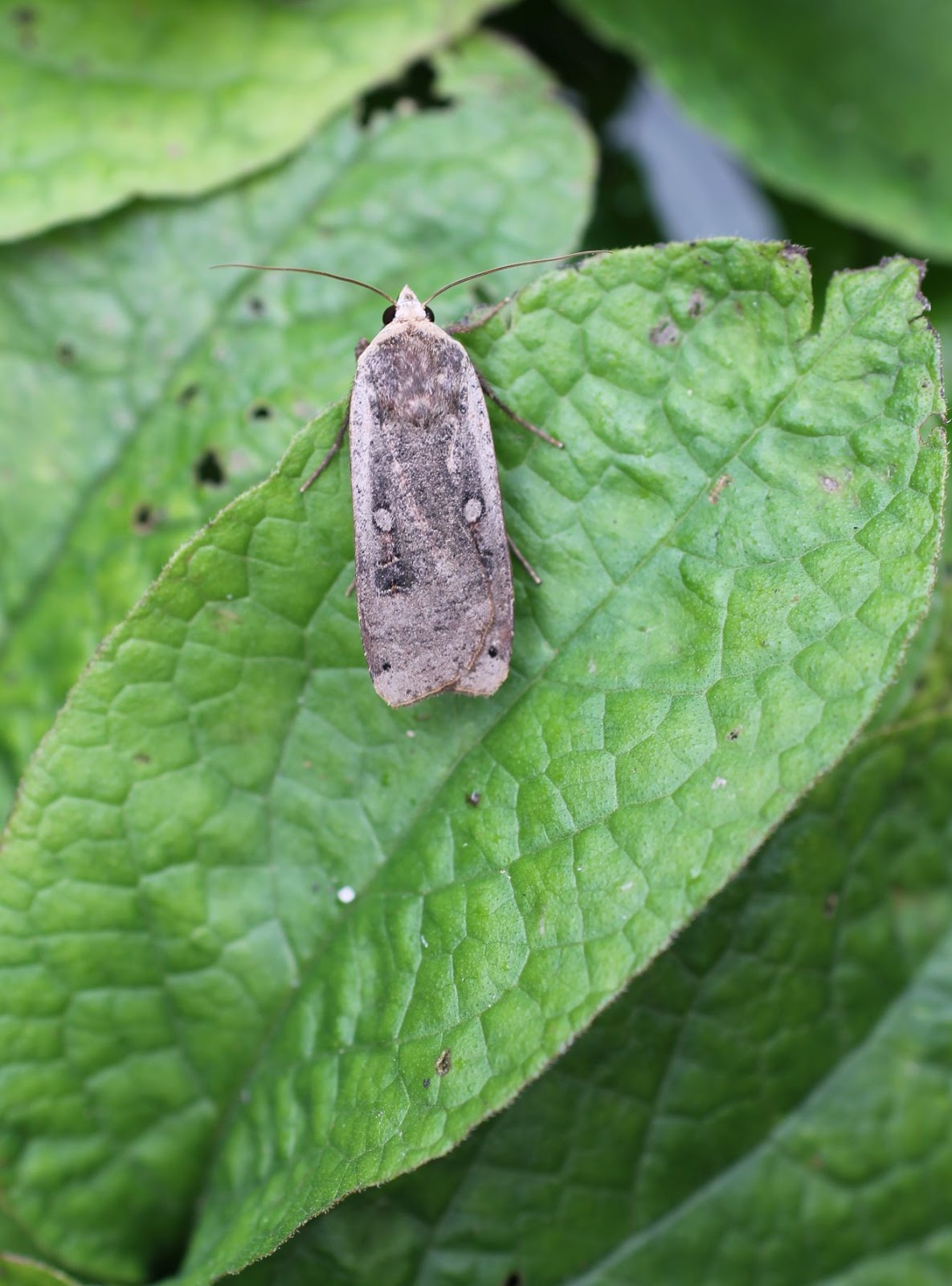
Lesser Yellow Underwing (Noctua comes)
The first thought was 'Lunar Underwing' but that moth doesn't seem to incorporate the dark triangular markings towards the wing tips; then 'Lesser Yellow Underwing' which I could have easily determined if I had encouraged the moth to move and display its coloured hindwings - if it had them.  I have looked at Rustics and Quakers but cannot find one to  match it sufficiently accurately.  I'll have to wait for an expert to point out the diagnostic points of the wing patterns.  I think it must be an underwing...

PS.  It's a Lesser Yellow Underwing after all - thanks to Charlie Fletcher's diagnosis.

Northern Spinach (Eulithis populata)*
If correct, this moth took a while to identify, mainly because it is worn and the markings on the wings are blurred.  Normally the abdomen of the Northern Spinach (Eulithis populata) - for that is what I believe it to be - is raised, somewhat like the Phoenix (Eulithis prunata), which would have helped had this moth taken up that attitude. If I am correct this is only the second time I have seen this moth at Shandy Hall - a far better specimen and photograph can be seen here.

PS. And this turned out to be a Dun-bar (Cosmia trapezina) and not a Northern Spinach after all.  In the field guide there are five varieties of this moth and there is one that corresponds to the photograph above.

*Errata: Dun-bar (Cosmia trapezina) 

Feathered Gothic (Tholera decimalis)
A regular annual visitor to the gardens, the Feathered Gothic (Tholera decimalis) will have overwintered as an egg.  The eggs will have been distributed over grassland, similar to the Swift moths, and when the larvae hatched they will have fed on grasses, including Mat-grass and Sheep's-fescue. Poda von Neuhaus (1723 - 1798) an Austrian entomologist, is the name linked to this moth.  He was the curator of the astronomic observatory in Graz and was a professor of maths and physics.  Perhaps his night-time observations lead to a mothy interest.

(Bryotropha domestica)
Keeping its head down in the tight crease of the egg-box at the bottom of the trap was a new moth. I am convinced that Bryotropha domestica is the species photographed and raises the total number to 445.  

The scientific name refers to the Greek for moss (bruon) and trophe (food) indicating the possible food source - moss; which often grows on houses, hence the 'domestic' reference. But this moth does not live indoors.  
This particular one was well marked and quite shiny and not too difficult to identify.  

Hermann von Heinemann (1812 - 1871) was a customs inspector and author of The Butterflies of Germany and Switzerland and it is his name that is associated with this little moth. 

  (Acleris laterana) or (Acleris comariana)
Another. I have searched diligently and (I thought) carefully to end up with identities which may well be incorrect.  The moth is either Acleris laterana or Aclaris comariana. Or at least I think it is.  The Acleris family are well represented on this blog.  The family name means 'unallotted', perhaps so devised to accommodate species that were not allocated to another.  

If a search of this site is undertaken (on the home page) using the word 'acleris' you will find  a number of moths of a similar shape, looking somewhat like shields and often beautifully decorated.  The one in the photograph has the reddish-brown colouring that could identify it as laterana : a brick; but it could equally be comariana : marsh cinquefoil, a larval food plant.  

Whichever of these two species it turns out to be will raise the number once again.

PS.  The third post scriptum reveals that laterana and comariana  cannot be identified without dissection so this new moth is number 446 - but it is either one or the other.  What a confusing trap that turned out to be - good preparation for National Moth nights this weekend. 


24 July 2012 - The Leopard of North Yorkshire


Leopard Moth (Zeuzera pyrina)

After clearing out all the Caddis flies and midges, we made some great discoveries: five new species! Current Count: 218.

The Leopard Moth (Zeuzera pyrina) was resting on the sheet nearby the trap. This is typical of its behavior as it’s a nocturnal moth but can often be found out in the open during the daytime. It doesn’t seem very safe for such a conspicuously colored moth. Zuezera is a misspelling for ‘zanzara’ (Italian for gnat) in respect of its larva’s bite. The larvae mine into the wood of living trees, an impressive feat for such small mouths. Pyrina (pear) is one of the types of trees that the larvae eat.

White Satin Moth (Leucoma salicis)
The White Satin Moth (Leucoma salicis) was strikingly white and had a furry head. With its clean and soft appearance, it could be the poster child for luxurious living… if only such establishments were more welcoming of insects. Leucoma means ‘white hair’ and salicis comes from Salix, the larvae’s foodplant.

Agapeta zoegana
We were thankful to find the Agapeta zoegana because we prematurely released one earlier in the week, thinking it was just the Agapeta hamana with a more saturated yellow coloring. Agapeta (beloved or desirable) comes from its attractive appearance. Zoegana is derived from J. Zoega, a Swiss entomologist who trapped the moth while he was staying at Carl Linnaeus’ residence. Linnaeus, as you may know, was an eighteenth century scientist responsible for the binomial nomenclature system. Some people have all the connections!

Aspilapteryx tringipennella*
Next we found the Aspilapteryx tringipennella. Patrick pointed this micro-moth out to me, because I’d overlooked it. Aspilapteryx means ‘spotted wing’ and tringipennella means ‘Tringa wing’ for the wing of the sandpiper bird’s genus which it was thought to resemble.


Red-barred Tortrix (Ditula angustiorana)
Finally, we come to the Red-barred Tortrix (Ditula angustiorana). It only stayed for a moment, so the photograph is not the best quality. Ditulos means ‘with two humps’ because of the two sections made by the crest marking on its thorax. Angustior means ‘more narrow’ because it is narrow in comparison to similar species.

There were a few other beautiful moths this morning. They were not new, but I couldn’t resist posting their photographs. The Mother of Pearl looked like a macro-moth but it is actually classified as a micro. The Lesser Broad-bordered Yellow Underwing has a green head, yellow underwings, and a pinkish underside. Its incredibly colorful for a moth that just looks dark black at first glance.

Mother of Pearl (Pleuroptya ruralis) 
Lesser Broad-bordered Yellow Underwing (Noctua janthe)
-Post by Helen Levins

*may be Metzneria metzneriella - Jane Wu

1 August 2019 - Food for Bats

Chinese Character (Cilix glaucata)
The Chinese Character (Cilix glaucata) can usually be found tucked into a space that it seems to create all for itself.  Whilst the Mother of Pearls, the Underwings and the Elephant Hawk-moths are whirring around, this bluish-grey (glaucus) little moth remains serene and undisturbed imitating a bird-dropping.  The cilix part of its scientific name refers to Cilicia, a coastal region of SE Asia to the north of Cyprus.

Broad-bordered Yellow Underwing (Noctua fimbriata)
The Broad-bordered Yellow Underwing (Noctua fimbriata) is one of those moths that can disturb everything and everybody when it gains access through the open window late at night,  cannoning and catapulting itself crazily around the room.  Its flight is rapid and vigorous and it can easily be disturbed by day from wherever it has chosen to rest.
Beautifully marked, the moth appears in a number of colours - the one above seemed less brown and more steely-blue when I photographed it, but the markings are consistent.  Nettles primrose and dock are the food sources for the caterpillar and the adult is much loved by bats - the brightly coloured underwings being the evidence that remains after the bat has made its meal.

Drinker (Euthrix potatoria)
The-sipper-of-dew, the lover-of-water could be alternative names for the Drinker moth (Euthrix potatoria) that appears regularly as July comes to a close.  A member of the group of moths known as the Eggars.  These moths tend to be thickly set and quite large and can be mistaken for tiny birds as the moths also fly during the day.  They do not feed in the adult state and the caterpillars provide a vital source of food for the increasingly scarce Cuckoo (Cuculus canorus) that is not deterred by the bristle-haired larvae.

No new species found in the gardens for quite some time but at least the numbers of moths attracted to the mercury vapour light seem to be healthier than earlier in the year.

3 August 2011 - Wrapped in a veil

The past two moth-traps have had nothing of great interest to record.  Broad-bordered Yellow Underwings (Noctua fimbriata), Common Rustics (Mesapamea secalis), Common Footmen (Eilema lurideola)* and Wainscots (Mythimna pallens) making up the majority of low species counts.  Meanwhile the caterpillars are beginning to pupate.  A tiny hole in the corner of the cage (enlarged by a wren?) has reduced the population to about twenty-five as a number must have made it into the wild.  Freedom comes at a price and whether they will find such a regular supply of succulent dandelion leaves is another matter.  The photograph shows two caterpillars transformed into pupae; a pupa in a cocoon where a dandelion leaf has been used to act as a covering; a caterpillar about to pupate – its body becoming smaller and crescent-shaped and its legs adopting a position of prayer; and five others still hungry and ready to carry on for another day or two as caterpillars.  Three have spun cocoons on the floor of the cage and are entombed in suspended animation.
A trap will be tried tonight as the weather is warmer. 
*Eilema lurideola takes its name from the Greek for a veil, a reference to the way this moth wraps its wings around its body and luridus - the colour of pale straw.