Showing posts sorted by relevance for query Helcystogramma rufescens. Sort by date Show all posts

25 July 2016 - Arrowheads and Spears

(Evergestis pallidata)
Our next showstopper is the Evergestis pallidata, one of the bigger micros with astonishing markings. Shaped like a bulgy arrowhead, the creamy colored moth is fashioned with “hieroglyphs” in thin black lines, recalling for me the benzene rings I used to draw in organic chemistry. The termen is sharply delineated; an oblique and ink-washed streak shoots out from the apex. ‘Euergēs’ means well made and ‘esthēs’ garment – funny how we like to imagine these markings that are part of their anatomy (more like tattoos really) as items of clothes, e.g. argyresthia ‘silver dress’, the use of ‘cloak’ in several vernacular names, and so on. The second part of the name, pallidus means pale, and -ata a suffix for geometry. The larvae for this species live in flocks and feed on Winter-cress. The adults enjoy a fairly long flight season from May to September.

(Evergestis pallidata) The Grey Pearl

Here’s an illustration of our moth in the Humphrey book. I like how the wings are tinted with pink to suggest a pearly gloss.

(Helcystogramma rufescens)

Quite a different vibe is given off by the Helcystogramma rufescens. Not an arrow but a spearhead this time, the moth is almost uniformly reddish and overlaid with a light vein mark that branches at one-half like the Wainscots. Remember that thing where you try to touch your nose with your tongue? This moth does that very well, curving its palps all the way up to the crown of the head (don't try this at home). The antennae flatten out against the wings and are quite long, about half the wing length. Rufescens, or reddish, describes its ground-color.
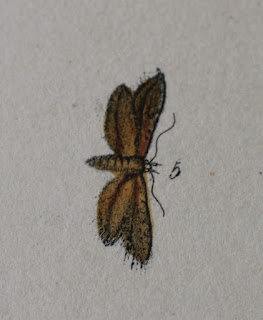
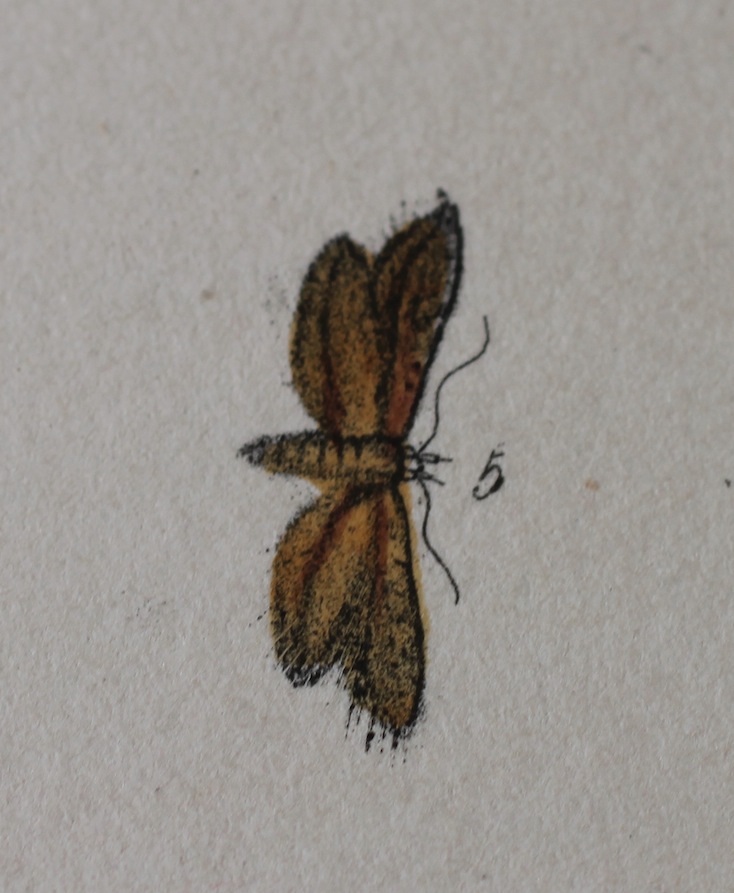
Helcystogramma rufescens - Illustration
It is named the ‘dwarf wainscot’ in this old illustration, under the genus Cleodora. Kleodora, was a prophetic nymph, who could tell the future by throwing pebbles. Does the oracle foretell the incoming of more new species?

The number of species is now 387.

Post: Tung Chau (UPenn)

22 July 2013 - New Sightings - the Micros.

With so many moths coming in each day we've been getting many new species - we may yet reach our goal of three hundred before I leave! I've divided the new micros and new macros into two different blog posts. Today is the micro post with four new species, bringing us to a total of 287 for now!

(Trachycera advenella)
Trachycera advenella is one of a few similar looking species. However, its counterparts, the T. suavella and T. marmorea are hardly to be found in Great Britain. An old classification puts them all under the Numonia genus. Advena means 'a stranger.' Johann Leopold Theodor Friedrich Zincken, who had given the moth its name (with a long name himself), lived in Brunswick, Germany. He was only able to find the moth there. 'A stranger' is meant to reference the moth's rarity - not as coming from abroad. This moth is, however, quite common in Britain.

Bud Moth (Spilonota ocellana)
For anyone who knows about micro-moths, they do not have common names very often. The Bud Moth (Spilonota ocellana) is one of a few exceptions. This is yet another bird dropping micro-moth - the fourth variety I believe I have identified here so far. This one flew straight at the wall in the arcade and I guess was trying to be one with the stone. Spilos 'a spot' and noton 'the back' have no relevance to this particular moth. These describe the original members of the genus which had a blotch on the backs of their wings. The Bud Moth was added only later to the genus and since then most of the other members have been removed. Ocellus 'a small eye' is given for the eye-shaped marking on the forewing.


Helcystogramma rufescens
This next micro-moth is one not particularly stunning, though it definitely has one of the longest moth names I've ever seen - Helcystogramma rufescens. This moth was also classified under a different genus once called Brachmia, after a German entomologist and lawyer from Mainz. Rufescens 'reddish' is supposed to describe the ground color of the wings, though examples I've seen of this micro-moth are only faintly tinged with color.


Aethes rubigana

Aethes rubigana is the last of the new micro-moths that we've identified. We had two of these. I really like their attractive yellow color. Aethes 'unusual, strange' possibly refers to this because yellow is not a usual color to see. Rubigo or rubiginis 'rust' comes from the rusty-looking markings on the wings.

- Post by Jane Wu