Showing posts sorted by relevance for query Eurrhypara hortulata. Sort by date Show all posts

21 June 2012 - A Wet Welcome


Green Arches (Anaplectoides prasina)
We welcome another new moth today, putting us at 189 identified species! I almost overlooked it because its shape and patterns seemed familiar. But thanks to Dr. Chesmore, it has been confirmed as the Green Arches (Anaplectoides prasina). Anaplectoides has a complicated meaning that has evolved from the moth’s relation to the Aplectoides, a North American breed. The word plektos (folded) is given because at rest, one wing is slightly folded over the other. Prasina (leek-green) describes the color of its forewings, at least until the sun fades them.


We had some other visitors who’ve been to Shandy Hall before, but are still beautiful and uncommon. Amongst these was the Burnished Brass (Diachrysia chrysitis) which caused quite a stir as I tried to position it for the camera. Its name is remarkably fitting for its appearance: Diachrysia means ‘interwoven with gold’ and chrysitis means ‘like gold’. While this may seem redundant, the name is fitting because its eye-catching metallic wings often warrant a double take.

Burnished Brass (Diachrysia chrysitis)
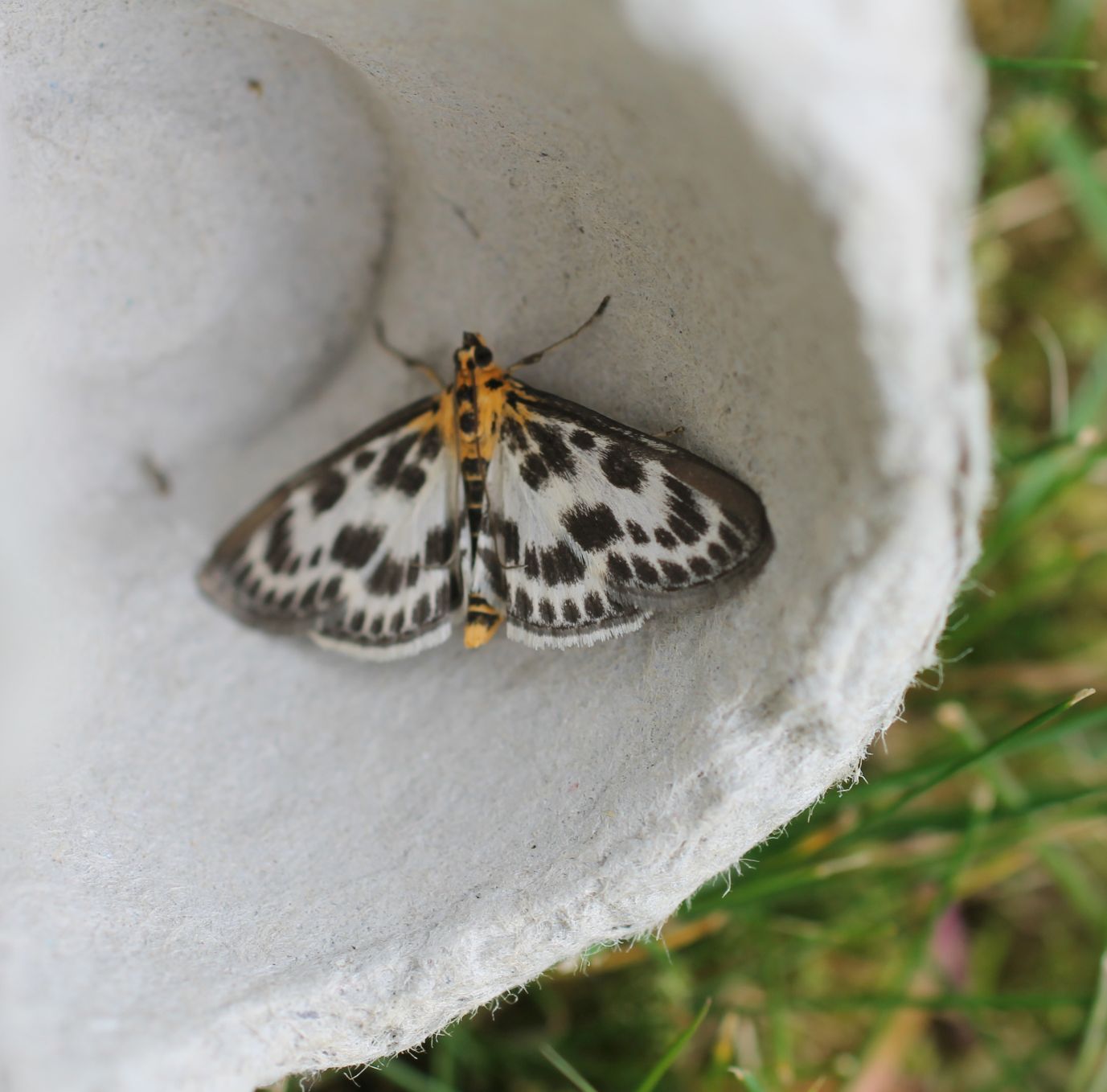
The Small Magpie (Eurrhypara hortulata) was much more cooperative. It held still with its Dalmatian-spotted wings fanned out, revealing the sunshine yellow details of its body. This summery species was likely attracted to the nettles and apple-trees in our gardens. Accordingly, it gets the name hortulata, meaning garden or orchard. Eurrhypara seems less valid: eu means ‘well’ and rhuparos means ‘greasy’. Feel free to disagree, but the Small Magpie to the left doesn’t look very greasy to me.

Small Magpie (Eurrhypara hortulata)
The Lime Hawk-moth (Mimas tiliae) also graced us with its presence. Although it has been here in the past, I couldn’t help myself from taking its photograph. In fact, the moth itself must know how beautiful it is… you can see how it faces its own reflection in the wall of the trap!

Lime Hawk-moth (Mimas tiliae)
As usual, we had an abundance of Carpets, Ermines, Common Swifts, Beautiful Golden Y's, and a few Heart and Darts. Hopefully the stormy weather breaks tonight so that our streak can continue.


Important! Moth Night 2012 is this weekend. The organizers (Atropos, Butterfly Conservation, and the Centre for Ecology & Hydrology) are asking moth trappers across the nation to report on the contents of their traps for at least one night of this weekend. It will vastly improve their database, which is so useful for all of us moth enthusiasts. More information can be found here.


Post by Helen Levins

7 June 2018 - First Catch


Blood-vein (Timamdra comai)

My first morning examining the moth trap I learned that long, unruly hair and micro moths do not mix well. After tying up my hair, the second thing I learned was that there were many more moths in the trap than I had imagined there would be – even after researching what to expect the night before. While none of the moths were new to the garden, they were all new to me, and the following are a few of my favorites.


The first moths to catch my eye were the Poplar Hawk Moths, because of their sheer enormity in comparison to the rest of the brood. They have been featured on this blog before, so I won’t touch upon them now. The second moth that caught my gaze, however, was a lone Blood-vein (Timandra comai). This moth is stunning with silvery white wings, a red gash stretching across them, and a pink trim; all of which works together to give this delicate moth the appearance of being bloodshot. 

Beautiful Golden Y (Autographa pulchrina)

Another favorite from this first catch was the Beautiful Golden Y (Autographa pulchrina), as well as its relative the Silver Y (Autographa gamma). To me, these moths have the disposition of some old and alien creature, forgotten by both nature and time. 

Small Magpie (Eurrhypara hortulata)
There were two Small Magpies (Eurrhypara hortula) in the trap as well. The Small Magpie is a very fashionable micro moth, with statement black-on-white detailing and slight pop of color. The scientific name refers to the sheen (rhupara meaning 'greasy') on the wings  and the food plant is the nettle in apple orchards (hortulus).  Any moth that lives on nettles should be praised. 

The rest of the catch consisted of too many Buff Ermines to count, as well as some White Ermines, Common Swifts, Green Carpets, a Burnished Brass and a Brimstone. What an exciting thing, to suddenly be able to know and distinguish the often overlooked inhabitants of the world around us! Looking forward to getting to know more. 


Post by: Gabriella Morace (UPenn intern)

17 June 2014 - King and Beggar


Purple Clay

The new addition to Shandy Hall moths came to us in the most inconspicuous way.
A Purple Clay (Diarsia brunnea) was found crouching in the cell of an egg-box this morning. The second part of its scientific name brunnea (brown, earth-colored) correlates to 'clay'.  As its name suggests the moth is rather unassuming in appearance.  The colors of its wings are dark and indistinct, possessing neither the elegant, high-contrast patterns of the Small Magpie (Eurrhypara hortulata), nor the playful colours of the Brimstone Moth (Opisthograptis luteolata) - both species found in the trap as well.

However, when I observed it more closely, in the light, I noticed its concealed beauty.  It's wings showed a glimmer of purple, the furry surface suddenly looked like fine velvet.  It reminded me of the luxurious robes of royalties of the past; purple, after all, is a regal color.


Ingrailed Clay (Diarsia mendica)

As the Purple Clay's kinsman, an Ingrailed Clay (Diarsia mendica) was also recorded and photographed for the first time, albeit having been previously identified.  It had a pair of light-brown wings carrying characteristic black markings. On the whole the Ingrailed Clay appeared more ordinary.  To complete the hierarchy of the moth world, the mendica (a beggar with a drab appearance) seemed to fall somewhat below its royal kinsman.

The Purple Clay brings Shandy Hall moth number: 339.


Illustrations of: Purple Clay (above) and Ingrailed Clay (below)


Post by Bowen Chang

26 May 2020 - New Species in the Garden

(Isotrias rectifasciana)
This moth perplexed me.  I didn't think I had seen it before but no matter how carefully I compared my photograph with the drawings in the Field Guide (illustrations by Richard Lewington) and the photographs in Manley's British Moths I couldn't be sure of its identity.  It was small with brown, speckled markings on a creamy ground with three bands across the wings. After an hour trying to weigh up which it was, I gave up and sent the photograph to Yorkshire expert, Charlie Fletcher, who informed me it was Isotrias rectifasciana.  The Norfolk Moths website gives it the title of 'Hedge Tortrix' and records that it is scarce.  This is the first time this little moth has been recorded at Shandy Hall and brings the number of different species to 439.

The scientific name is descriptive isos meaning 'equal'; trias meaning 'group of three' - referring to the bands on the forewings; rectifasciana or 'the straight band' across the centre where other members of the Tortricids have an oblique  mark.  The food plant is not known but it is probable that hawthorn might satisfy the caterpillar.
 
Broom Moth (Melanchra pisi)
This moth caused a lot of head scratching as well.  At first it was hoped that a Knot Grass (Acronicta rumicis) had been drawn to the light of the trap - a moth that should be in this locality but has not yet been seen.  It wasn't a Knot Grass but a Broom Moth (Melanchra pisi), a moth that has only been seen once before in 2013.  I am glad to know it is still around.  The description of its habitat and food source can be seen here, on the blog that was posted by our intern, Jane Wu, on that occasion.
 
Scorched Wing (Plagodis dolabraia)
The following three strikingly marked moths were photographed with relative ease.  The Scorched Wing (Plagodis dolobraia) is always a delight but will take to the wing at the slightest provocation. I waited for it to crawl up the wooden strut of the collecting cage until it felt contented to settle.  A few purposeful but gentle wing beats indicating that it was now going to remain in the chosen spot. 
 
Small Magpie (Anania hortulata)
Like the first moth in this little group, the Small Magpie (Anania hortulata) is a micro moth even though it looks more the size and shape of a macro.  Since it was last recorded on the blog it seems to have changed the first half of its scientific name from Eurrhypara (meaning 'greasy' and referring to the glossy sheen of the wings) to Anania (meaning 'without pain' or ironically 'with pleasure'). 

 
Small Angle Shades (Euplexia lucipara)
The third moth is the Small Angle Shades (Euplexia lucipara) a very compact and attractive moth with clear and uncomplicated markings.  The scientific name refers to the position of the wings when the moth is completely at rest. 'well woven' or 'plaited' (eu plexis) they form a small ridge to make the insect resemble a leaf; lucipara refers to the 'bringing forth of light' in the form of the yellowish marking.  The moth has two generations and the caterpillar will feed on ferns, bracken, nettles, currants, birches, sallows - all found in parks and gardens throughout the country.

Other species in last night's trap were : Gold Spot, Poplar Hawkmoth, Green Carpet, Silver Ground Carpet, Spectacle, Heart and Dart, Straw Dot, Pale Tussock, White Ermine, Buff Ermine, a couple of pugs and more cockchafers than I have ever seen before.