Showing posts sorted by relevance for query Cryptoblabes bistriga. Sort by date Show all posts

3 July 2012 - Discovering the "Hidden"


Cryptoblabes bistriga
We await confirmation on a few species, but we do have one new moth today! It was a cloudy, but still warm welcome for species number 195. The Cryptoblabes bistriga, our latest micromoth, stayed around just long enough for me to photograph him. Its name, crypto (hidden) blabe (damage), refers to the larvae that feed on the insides of folded oak and alder leaves, leaving the damage unnoticed from the outside. This is a very uncommon species, and had I known that this morning I would have kept a specimen for Dr. Chesmore to have a look at. I guess this is just a challenge for me to catch another Cryptoblabes bistriga before heading home.

*Editor's Note: Since publishing, the following moths have been identified. These results give us an additional 3 new species (Common Wave, Aethes cnicana, and Eucosma cana). Refer to the captions of their photographs for their respective names.

This next species, I’m not sure about. I think it could be the Aethes cnicana but let me know if you think otherwise. Aethes means unusual or strange and referred to a number of moths that were found to be yellowish in color. Cnicana, for Cnicus, is a synonym of Cirsium, the genus of its larvae’s foodplant. This makes me a bit more affirmative in my guess, because our gardens have plenty of thistles, a variety of Cirsium.
Confirmed: Aethes cnicana
The last moth I will try to identify is the Riband Wave (Idaea aversata). Idea for Mt. Ida is the grandstand where the gods and goddesses congregated to watch the Trojan War. Aversata is for aversus (belonging to the hinder or under part), because its markings are more visible from the underside than from above.

Confirmed: Riband Wave (Idaea aversata)
I’ve included photographs below of some moths that I can not identify. I hope to have the answers tomorrow. In the meantime, do you have ideas?
Confirmed: Common Wave
Confirmed: Eucosma cana

-Post by Helen Levins
Confirmed: also Eucosma Cana

7 July 2017 - Sipper of Dew


Yellow-tail (Euproctis similis)

Last night’s trap, in my opinion, was a success. While we did not increase the number of species to Shandy Hall, there were plenty which I have never seen before, including some interesting macro moths.

The Yellow-tail (Euproctis similis) was one of those. It was one of the first moths I noticed when looking into the trap as the light bouncing off its white body made it shine, almost like a beacon. The infamous yellow tail was not visible at first, but viewing the fluffy moth from a different angle exposed the golden abdomen. Its scientific name refers to its yellow tail, as Eu means ‘good’ and proctis means ‘backside’. The other half of the binomial similis means ‘similar’ because it resembles the Brown-tail (Euproctis chrysorrhoea) species. The larvae of the Yellow-tail feed on deciduous trees and shrubs.

The Drinker (Euthrix potataria)


As I was examining one of the egg boxes, looking closely for any micro moths, I looked underneath and there lay a peculiar shaped moth. This moth is called The Drinker (Euthrix potatoria), and it was resting in a spot previously occupied by an egg; the two don’t look too dissimilar either. I may go so far as to call it cute even, with its seemingly chubby body and pointed head. Its name Euthrix means ‘hair’, describing the hairy adult, and potatoria means ‘pertaining to drinking’, referring to the drinking habits of the larvae. 
Grasses and reeds make up the main diet for the caterpillars of The Drinker, but they also have an attraction to drops of dew, hence its name.

Double Lobed (Apamea ophiogramma)


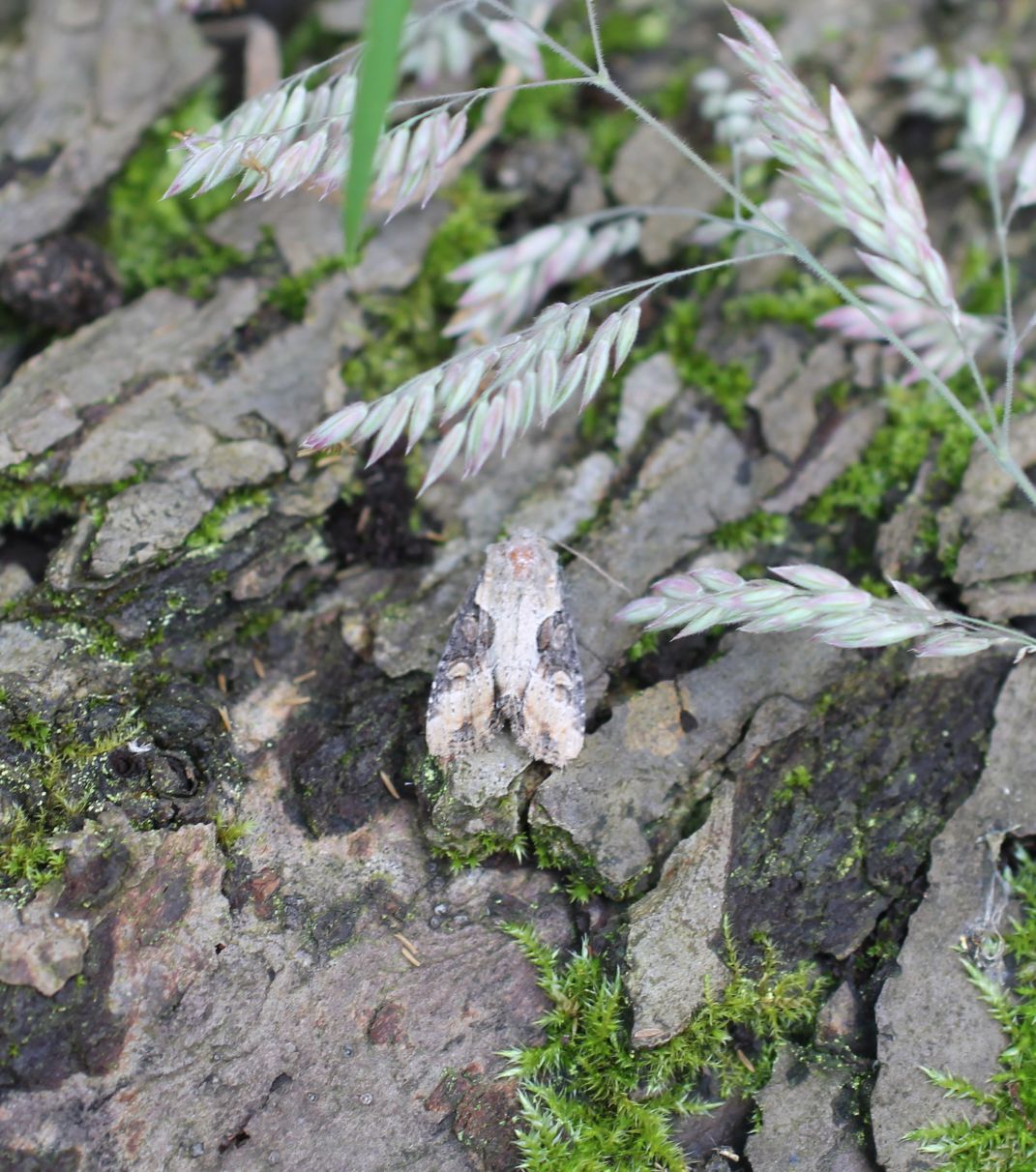
The Double Lobed (Apamea ophiogramma), was another moth found in our trap from last night. It can be easily identified with its unmistakable pattern of two circular lobes, one on each wing. Apamea ophiogramma, meaning ‘snake marking’, makes reference to the meandering edge creating a partition between the two contrasting light and dark colors. The larvae feed on reed canary-grass (Phalaris arundinacea) and reed sweet-grass (Glycera maxima).  I need to confirm whether either of these plants are in the gardens here in Coxwold.

Along with these three species, we have also found Cryptoblabes bistriga, Clouded Silver, Common Emerald, Crambus lathoniellus, Green Arches, Elephant Hawk-moth, Muslin Footman, and Mottled Rustic, to name but a few.


Post : Walter Chen [UPenn intern]