Showing posts sorted by relevance for query Arctia caja. Sort by date Show all posts

11 July 2016 - Spot the Difference

(Eudonia mercurella)
Last Thursday we had one of the most productive traps since I arrived. An impressive 45 species including Clay, Agapeta hamana, Aethes rubiferana, Dark Arches, Green Pug, and the majestic Garden Tiger were captured. This made a stark contrast to the night before, where the only notable finding was a Purple Clay. A good number of Barred Straw, Udea Olivalis, Silver Y, and Silver-ground Carpet were fluttering about upsetting all the others, so we might have lost a couple species before they could be identified.

Garden Tiger Moth (Arctia caja)

A series of coincidences led to my cousin unearthing a Burberry 2013 F/W design that I could swear was a tribute to the Garden Tiger. Recalling Valentino’s “Camubutterfly” line in 2014, I wondered if it could be another bout of Lepidoptera invasion of the fashion industry. The official claim, however, let us down in saying that they took their print from giraffes – Giraffes! Our moth’s association with other animals does not stop there. Its scientific name Arctia caja is derived from ‘arktos’, meaning a bear, named for the hairy appearance of its larva. Caja is the female form of the Roman name Caius, as in Caius Julius Caesar.

Red Barred Tortrix (Ditula augustiorana)

The Red-barred Tortrix (Ditula augustiorana) has been recorded once before in 2012 but not properly photographed. This moth is so energetic and loves to dart around so much that even today’s photograph had to be taken with extra caution. It is one of the few micros listed as “Grade 1” on Flying Tonight, meaning it is easily identifiable even to inexperienced observers. The characteristic bold, viewfinder-like spot on its dorsum gives it away, as does the reddish-brown cross-band halfway down the body.

Marbled Orchard Tortrix (Hedya nubiferana)
Plum Tortrix (Hedya pruniana)

We were also presented with some tricky, spot-the-difference type of exercises. Suspecting they might be different species, I submitted the following pairs to Charlie Fletcher, who confirmed that they are indeed different. Out of the two Hedya’s, one is a pruniana (Plum Tortrix) and the other possibly a nubiferana (Marbled Orchard Tortrix). The latter is usually longer-winged, but the rest of the markings are hard to tell apart. The other pair (lucky I checked) turned out to be from different genera: one is a Scoparia pyralella and the other a Eudonia mercurella. The two are of similar size and shape, but the S. pyralella has a orange-brown tint that is absent in the E. mercurella. The latter supposedly has a broad X in between the termen and the second cross-line, which I failed to see.

(Scoparia pyralella)


Post : Tung Chau (UPenn)

5 July 2011 - Brightly coloured petticoats

Another week passes and this post must go up.  A Garden Tiger moth (Arctia caja) turned up.  What a wonderful moth it is.  Arctia from the Greek for ‘bear’ – the hairy larva is called the ‘wooly bear’ –and caja is taken from a Roman lady’s name (the female of Caius).  Linnaeus used feminine names for species with brightly-coloured hindwings and this moth certainly is a suitable candidate.  The red colouring is so intense. The caterpillars have now embraced a dandelion leaf diet and they are increasing in size at an alarming rate.  One larval skin-shedding has taken place and the hairs on their backs grow longer and longer. 
  

6 July 2014 - Small Dingy Tubic


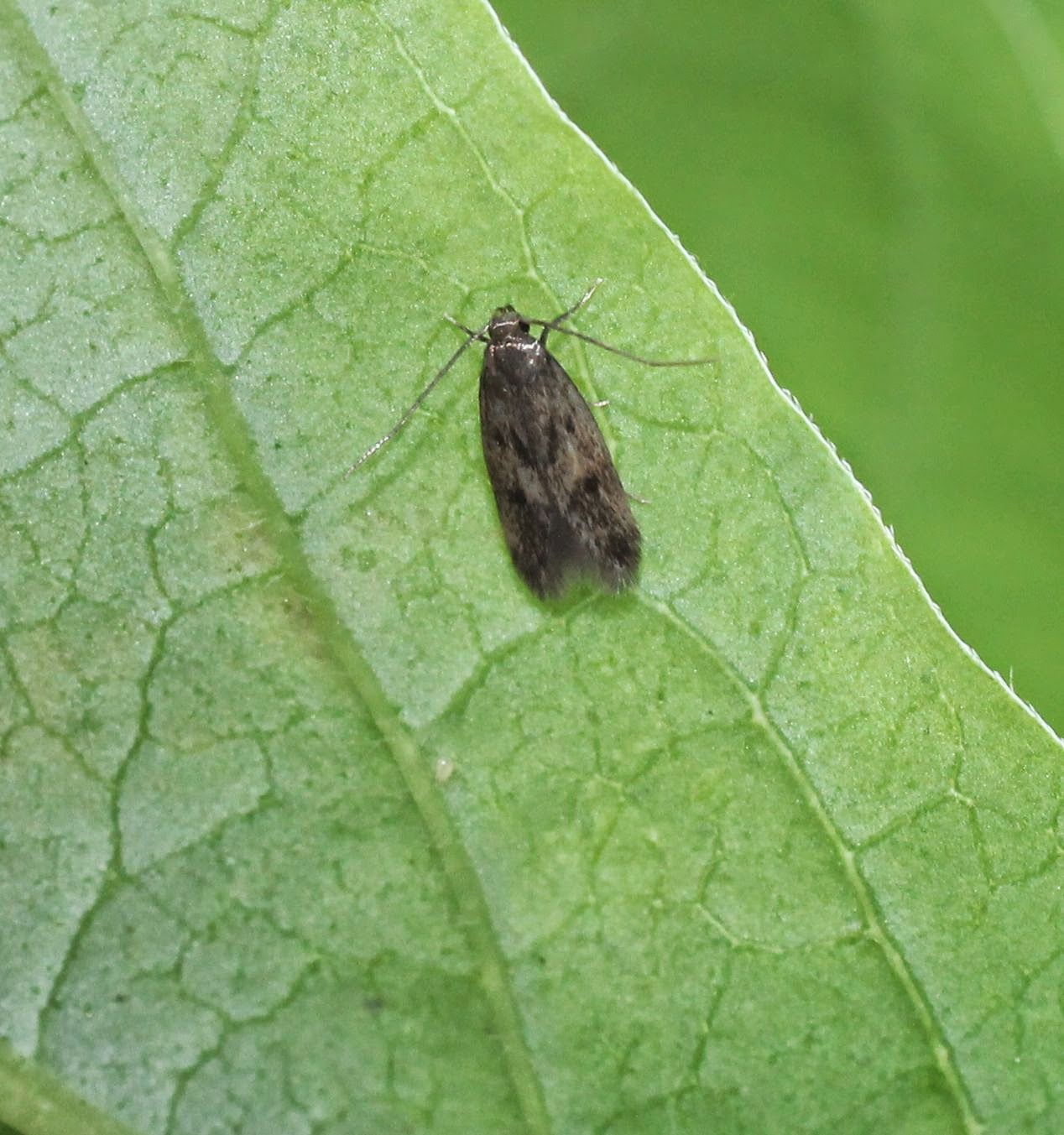
(Borkhausenia fuscescens)


Last night we had an impressive catch at Shandy Hall's gardens – not bad after recording an impressive fifty-four species for National Moth Night the night before. This morning a Poplar Hawk-moth (Laothoe populi) was seen perched on the side of the trap; a Garden Tiger (Arctia caja) displayed its high-contrast patterned wings; a Regal Piercer (Pammene regiana), with its remarkable yellow crown, also caught our attention.

What almost escaped our notice became the most important catch of the day. On the side of the trap's transparent lid rested a miniscule moth that is hardly remarkable in any way at all – besides, perhaps, being one of the smallest moths we've recorded since my arrival. It was a Small Dingy Tubic (Borkhausenia fuscescens). 'Fuscescens', or 'fuscuous', means to be dark and somber in color. Indeed, the moth's wings appeared muddy and brown. Little distinctive patterns could be made out besides two pairs of dark spots along the middle of each wing. What finally betrayed its identity was the long hairy edge of its wings. In contrast to the elegant 'trimmings' on the wings of, say, a Silver Ground Carpet (Xanthorhoe montanata), like an ornate Victorian dress, the hairy wings of the Small Dingy Tubic reminded me of the furry coats of a steppe rider. It's important, I suppose, for a moth this small to carry a somewhat hardy appearance.

So far, we've recorded 348 different species of moth. We hope July will continue to add new species to the list.

On Wednesday morning (9 July - from 7.00am until around 10.30am), if you are near the Museum Gardens in York, the moth catch from the previous night can be seen on our stand near the observatory.

Post by Bowen Chang (UPenn)