Showing posts sorted by relevance for query Apamea ophiogramma. Sort by date Show all posts

7 July 2017 - Sipper of Dew


Yellow-tail (Euproctis similis)

Last night’s trap, in my opinion, was a success. While we did not increase the number of species to Shandy Hall, there were plenty which I have never seen before, including some interesting macro moths.

The Yellow-tail (Euproctis similis) was one of those. It was one of the first moths I noticed when looking into the trap as the light bouncing off its white body made it shine, almost like a beacon. The infamous yellow tail was not visible at first, but viewing the fluffy moth from a different angle exposed the golden abdomen. Its scientific name refers to its yellow tail, as Eu means ‘good’ and proctis means ‘backside’. The other half of the binomial similis means ‘similar’ because it resembles the Brown-tail (Euproctis chrysorrhoea) species. The larvae of the Yellow-tail feed on deciduous trees and shrubs.

The Drinker (Euthrix potataria)


As I was examining one of the egg boxes, looking closely for any micro moths, I looked underneath and there lay a peculiar shaped moth. This moth is called The Drinker (Euthrix potatoria), and it was resting in a spot previously occupied by an egg; the two don’t look too dissimilar either. I may go so far as to call it cute even, with its seemingly chubby body and pointed head. Its name Euthrix means ‘hair’, describing the hairy adult, and potatoria means ‘pertaining to drinking’, referring to the drinking habits of the larvae. 
Grasses and reeds make up the main diet for the caterpillars of The Drinker, but they also have an attraction to drops of dew, hence its name.

Double Lobed (Apamea ophiogramma)


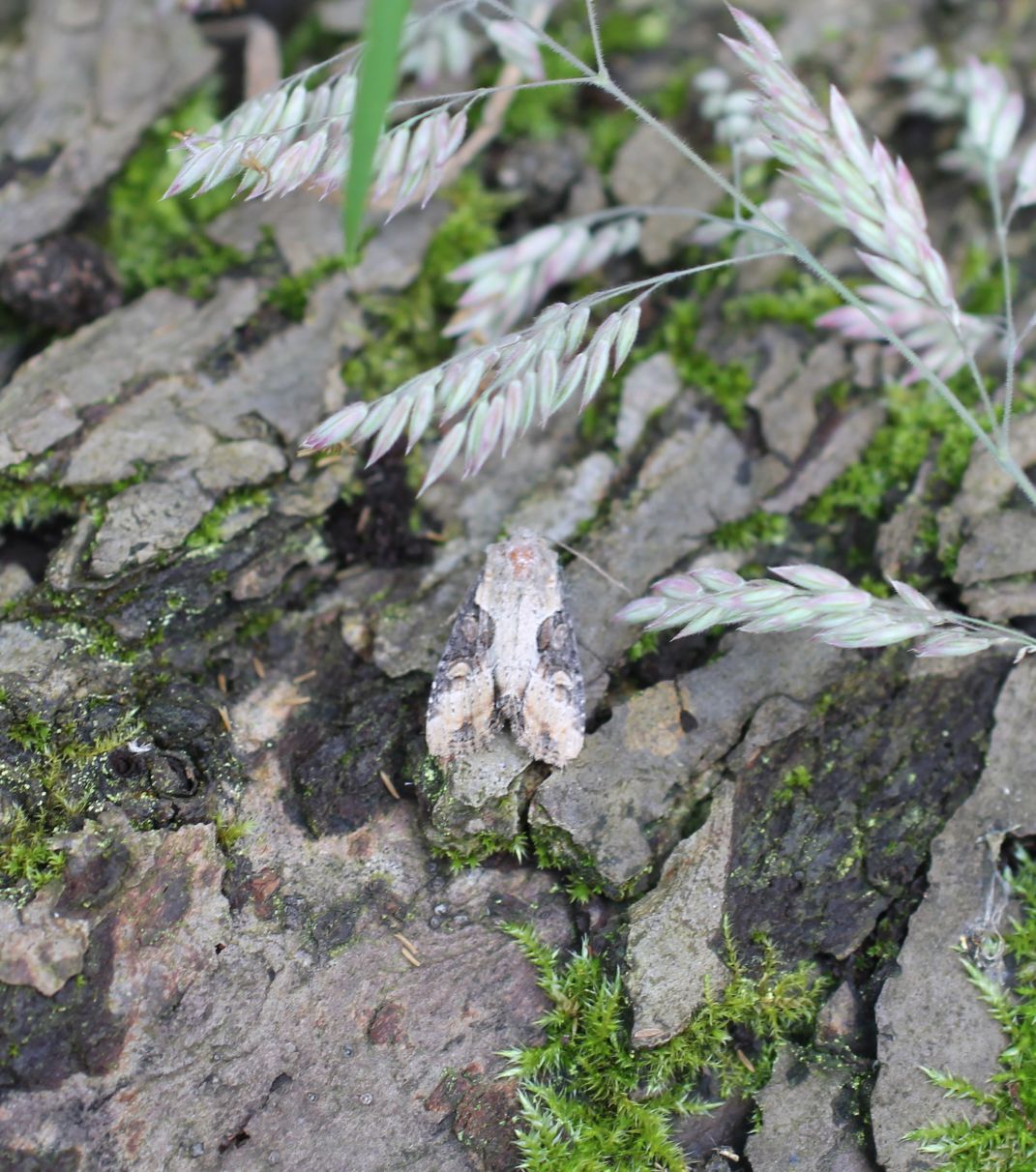
The Double Lobed (Apamea ophiogramma), was another moth found in our trap from last night. It can be easily identified with its unmistakable pattern of two circular lobes, one on each wing. Apamea ophiogramma, meaning ‘snake marking’, makes reference to the meandering edge creating a partition between the two contrasting light and dark colors. The larvae feed on reed canary-grass (Phalaris arundinacea) and reed sweet-grass (Glycera maxima).  I need to confirm whether either of these plants are in the gardens here in Coxwold.

Along with these three species, we have also found Cryptoblabes bistriga, Clouded Silver, Common Emerald, Crambus lathoniellus, Green Arches, Elephant Hawk-moth, Muslin Footman, and Mottled Rustic, to name but a few.


Post : Walter Chen [UPenn intern]
24 July 2013 - Caterpillar Overload.

Double Lobed (Apamea ophiogramma)
I've been going over some old moth records here at Shandy Hall and have identified 4 moths that we haven't had before this summer! The first is the Double Lobed (Apamea ophiogramma) from July 8, 2013. This is the only one we've found so far. This moth is extremely distinctive due to the two 'lobe' shapes on its wings. It is of the same genus as the Dark Arches, Clouded-bordered Brindle, and other moths that we've identified before. Ophis or ophio- 'a snake' and gramme 'a marking' are meant to describe the sinuous border between the lighter and darker parts of the wing. The larvae consume reed canary-grass and reed sweet-grass.


Dotted Clay (Xestia baja)

Next is the Dotted Clay (Xestia baja). It is most easily recognizable by the small dark dots near the shoulders and dark marks near the wing-tips. The kidney-shaped marks are usually distinct enough to recognize, but do not normally stand out. Xestos 'polished, smooth' describes the glossy sheen on some of the wings of moths of the genus, and badius means 'chestnut-colored.' The larvae are active at night and feed on bog myrtle, bramble, and other plants.

The next new species is a micro-moth by the name of Phlyctaenia perlucidalis. (Try saying that three times fast.) It looks quite similar to the Mother of Pearl at first glance, a much more common micro-moth that we've been finding in larger numbers. The Phlyctaenia perlucidalis was first found in England is 1957, though numbers have been increasing in the past few decades and its territory has expanded greatly. Its genus name is not particularly flattering - phluktaina meaning 'a blister.' This is for the pale circular blotches that are found on other moths of the genus. For a genus with so many beautiful moths, I find this name quite inappropriate. Per 'intensive' and lucidus 'bright' are much better terms by which to describe this lovely micro-moth.

Phlyctaenia perlucidalis
Large Twin-spot Carpet (Xanthorhoe quadrifasiata)
The Large Twin-spot Carpet (Xanthorhoe quadrifasiata) is a recent find. We caught 6 total in the past week. As with most Carpets, these were very flighty and left as soon as they were able. The photograph above was a difficult one to take as I'm sure the moth would have been more content hiding in some shrubbery instead of on the inside of a moth cage. This moth also does not have the best name. Xanthos 'yellow' and rhoe 'a stream' are descriptions of the yellowish bands on some of the moths of the genus. The Large Twin-spot Carpet does not have these. Quadrifasiata is a typographical error for quadrifasciata. Quadri- 'four' and fascia 'a band' may be to describe the bands of the wings, though why 'four' I am unsure, as this moth does not have 4 distinct bands that I am aware of. The larvae like to feed on bedstraw and other low-growing plants.

Our moth count is now at 294! We're getting close!


White Satin Moth (Leucoma salicis) egg capsule
Lastly, an update from the Caterpillar Foundling Nursery of Shandy Hall: we've yet again been left to care for a set of moth eggs, this time from a White Satin Moth (Leucoma salicis)! The White Satin Moth lays its eggs and then secretes a hard pearly covering over them to protect them. The mother has been perched nearby for a couple days now. We wonder when she will fly off... Patrick and I have also been discussing whether or not to let some of our other caterpillars go. They have grown quite large and there are enough of them now that taking care of them has become quite time consuming. We will perhaps let some of them free soon. We may keep a few to see what they turn into.

- Post by Jane Wu