Showing posts sorted by relevance for query Anticlea badiata. Sort by date Show all posts

10 April 2014 - The Grief of War


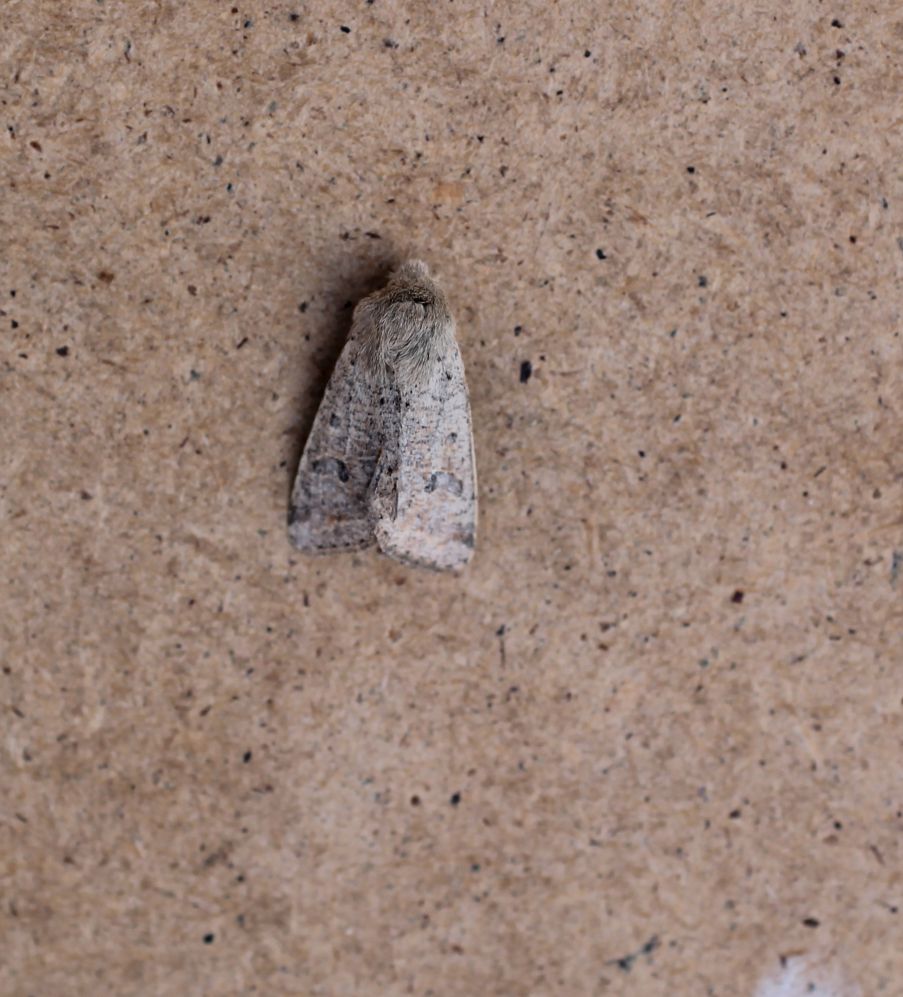
Shoulder Stripe (Anticlea badiata)
 It would be either a Shoulder Stripe or a Water Carpet, or at least that is what I thought when this delta-winged moth appeared this morning.  Shoulder Stripe (Anticlea badiata) was what it turned out to be.  The woody markings and upraised abdomen making a delightful picture. Look carefully and you will see how the different bands of colour on the antennae (almost hidden on the surface of the wings), mirror the colours beneath - each different section fitting exactly to each different background. Remarkable and complete in repose.  The Shoulder Stripe can be seen in many different shades but the wing patterns are always the same.  Anticlea was the mother of Ulysses.  She died of grief when her son was absent for six years during the Trojan war; badiata means 'bay coloured'.


The image above shows the abdomen when the moth is resting - or sleeping - or whatever moths do during the day.  Staying out of sight is their speciality.

Beneath can be seen an illustration of the Shoulder Stripe flitting among bedstraw, which is not the food plant.  This moth has been recorded 'drinking fluid on rose-hips'.  A worthy new species - number 330.


30 March 2019 - Frosty Moths

Box of Moths

Before setting up the moth trap last night I went to that trusty source of internet information known as Yorkshire Moths Flying Tonight.  A list of possible moth-visitors to the gardens, woods, meadows and parks of this large county is there to refer to and I hoped that my memory might be refreshed and that I might recognise the majority of those found this morning.  What I did discover was a larger number than I had anticipated especially as the grass was frozen. 

The first photograph gives a smattering of what turned out to be quite a number of different species and a number of each variety too. I placed one of each apparent species in the box, checked its identity and then compared the known with the remainder - of which there were around sixty.  

Some were simple - the Shoulder Stripe (Anticlea badiata) for example. Straightforward to identify, I photographed it and left it in peace remembering the last time I encountered this moth it didn't take kindly to being disturbed.  The scientific name comes from Anticlea, mother of Ulysses, who was so distressed by her son's absence at the Trojan War that she died of grief; badius means 'brown or dun-coloured' from the ground colour of the moth. 

Shoulder Stripe (Anticlea badiata)

The two examples of the Common Quaker (below) show how individuals of the same species can lead to uncertainty.  The markings on the moth on the sage leaf are rather muted compared to the one in the second photograph. 

Common Quaker (Orthosia cerasi)

Common Quaker (Orthosia cerasi)

The Small Quaker is reasonably easy to identify as it is considerably smaller than others of the same family. The wings are lightly speckled with black and this helps too.

Orthosia means 'to make straight' referring to the line at the base of the wings.  It is also an epithet of Artemis, goddess of the hunt.  The second part of the binomial crudas means 'unripe' or 'premature' referring to the adult's flight so early in the year.  Milton's poem Lycidas which is a lament for a drowned friend states: 'I come to pluck your berries harsh and crude...'

Small Quaker (Orthosia cruda)

The Hebrew Character is common in the gardens at Shandy Hall and common throughout the county.  The name refers to the black markings on the wings which vary a little from moth to moth but are generally consistent.  There must have been at least twenty of this species and all looked freshly hatched.

Hebrew Character (Orthosia gothica)


Hebrew Character (illustration)

The illustration from British Moths and their Transformations by Humphreys and Westwood (1843) shows the moth in flight.

Pale Pinion (Lithophane hepatica)
The Pale Pinion is not a common species and it was encouraging to find six in total.  Hepatica refers to the liver colouring to the wings which is not readily visible in the examples I found this morning.

Pale Pinion (illustration)


Clouded Drab (Orthosia inserta)

The scientific name for the Clouded Drab includes the word 'inserta' or uncertain.  This moth appears in a number of versions and is not easy to identify but I think this one is correct.
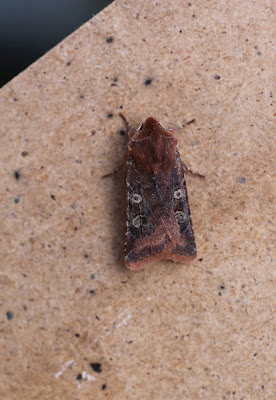

White-marked (Cerastis leucographa)

Finally - before the PS - here is the first new species of the year.  A White-marked.  This moth is exactly as the name describes, as you can see from the photograph.  Although lepidopterists have bred the moth in captivity, it seems that the caterpillar has never been seen in the wild.  Stitchwort, dock and sallow have fed the captive larvae but where the moth lays its eggs and what the larvae feed on, is a mystery.  Described as 'Local' both for the county and the country it takes the species count to 436.

Morel Fungus
PS  A surprise in the garden.  Could this unusual fungus (or truffle as some insist it should be called) be a source of nourishment for moths?  The extremely scarce Waved Black (Parascotia fulginaria) is a consumer of fungus so maybe this odd little organism has a particular place in the mothy scheme of things.

Early Grey (Xylocampa areola)

PPS The Early Grey (Xylocampa areola) has overwintered as a pupa and the warm weather has probably encouraged the adults to emerge.  The caterpillar feeds on honeysuckle.

That covers the first trap of 2019.

9 July 2013 - Timothy and the Foundling Caterpillar Nursery of Shandy Hall.

I believe Helen Levins came across a Timothy Tortrix (Aphelia paleana) last year when she was here, though it was recorded as an Aphelia unitana.  On reflection this is an unlikely identification as Aphelia unitana is a nationally scarce species. The coloration depicted in the main identification book that we use at Shandy Hall, the Field Guide to the Moths of Great Britain and Ireland, could have been a factor as the Timothy Tortrix is shown as yellow and the Aphelia unitana as a shade of white very similar to the specimens of the Timothy Tortrix that we've found. The difference is that the Timothy Tortrix has a slight yellowish suffusion around the head and base of the wings. Apheleia 'plainness' and palea 'chaff' describe this plain white with the suffusion of color on the wing. Why the micro-moth's name is 'Timothy' I am not certain, but one of the host plants is Timothy Grass (Phleum) so that may be the connection.  Our species count is now 276.


Timothy Tortrix (Aphelia paleana)

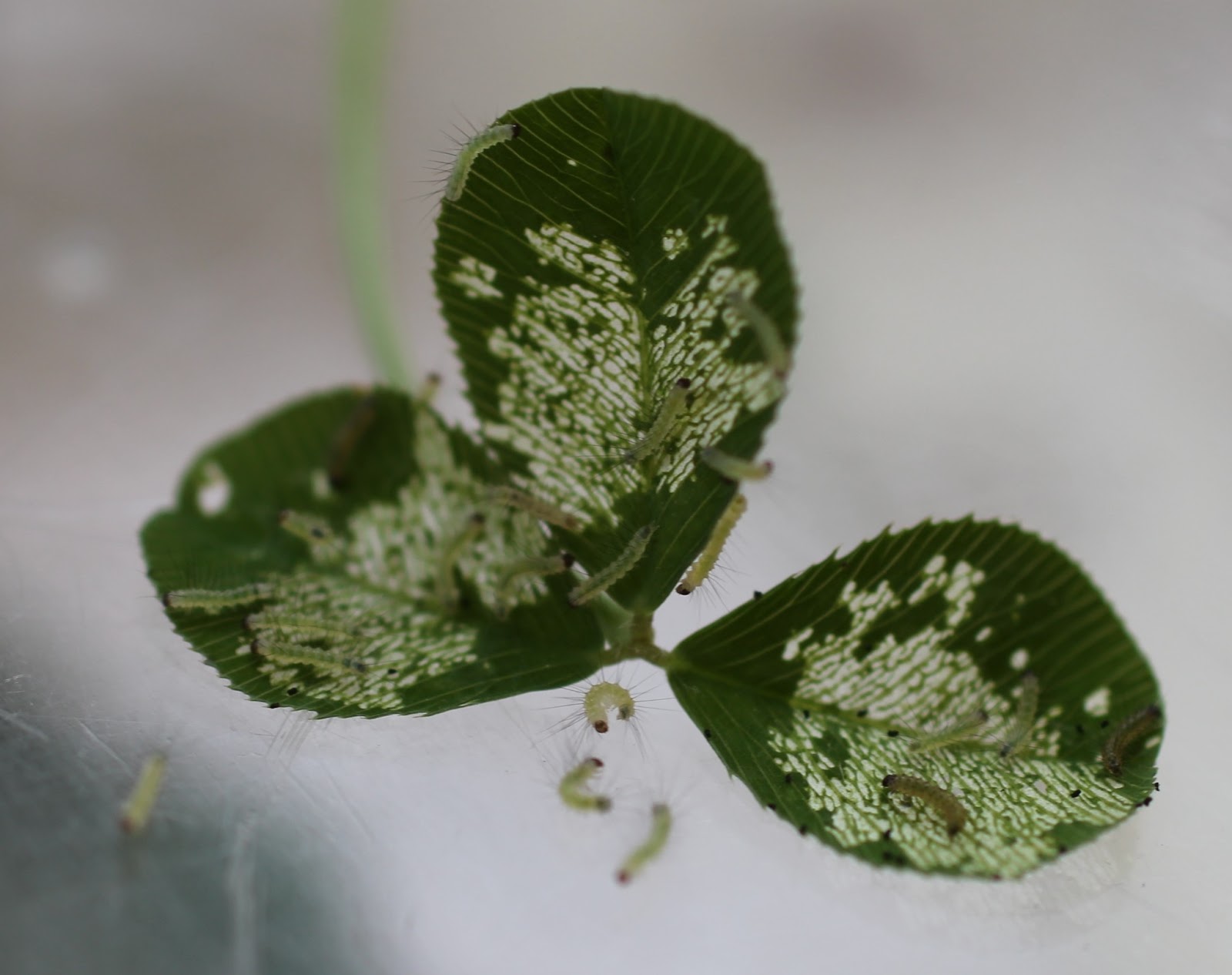
For even more exciting news, I've taken some pictures of our new additions to the Shandy Hall Foundling Caterpillar Nursery! (We were going to name it the Foundling Caterpillar Orphanage, but decided against that because that sounded too depressing.) Here are a few of our new occupants munching away on a piece of clover that Patrick has given them.

New Members of the Foundling Caterpillar Nursery

The looper caterpillar, possibly a Shoulder-stripe (Anticlea badiata), has now pupated! We've put it in with the Yellow-tails and are waiting for it to emerge.

Shoulder-stripe (Anticlea badiata) pupa

We've been collecting plenty of caterpillars lately. This one came to us by chance this morning. I found it in the moth trap. It had attached itself to a Sweet Rocket petal and drifted in by accident. We don't know what it is, but hopefully it takes to the Sweet Rocket leaf I gave it and we will find out!

Unknown Caterpillar Type

- Post by Jane Wu

9 March 2015 - Stirrings Still

Shoulder Stripe (Earophila badiata)

Last year (10 April 2014) the Shoulder Stripe was recorded as a new species for Shandy Hall. However the scientific name was different (Anticlea badiata) and its derivation was linked to Ulysses, war and grief.  In this alternative version (Earophila badiata) a different identity is conjured up and one that is more appropriate to the location of this photograph.  The Shoulder Stripe was spotted at 10am this morning in Kersey, Suffolk - one of the prettiest villages in England. The timbered houses crowd up to the ford (The Splash) and scramble up the hill to the magnificent, flint-napped church, passing on the way a road-sign of a blazing torch with the word 'Children' beneath. This village is of another era.

The moth had been lured to this location by an outside light and it had clamped itself onto the plaster close to the front door of one of these ancient buildings. I hope its camouflage (badiata - bay-coloured) will keep it safe until nightfall for it loves the Spring (from the Greek 'ear') and this morning was one of the most perfect of the season yet to come.

Recording a moth in Suffolk for a blog that is based in Yorkshire needs a connection and there is one.  Kersey cloth - a dense, warm woollen cloth - was made in the village in medieval times.  Another location was Calderdale.

18 April 2019 - The Cold Moon

Streamer (Anticlea derivata)

Despite the heat of the day, the full moon and clear sky made the temperature drop last night and the 12 Hebrew Characters, a Satellite and this Streamer was the sum total to be found this morning.  The Streamer has been trapped, identified, photographed and recorded already and this link will take you straight to the page and a fuller report.  The two photographs are similar in that they show the moth in their egg-boxes.  The Streamer has a tendency to launch itself into the air if disturbed.  The other member of the Anticlea family is the Shoulder Stripe (Anticlea badiata) which was recorded a few weeks ago.

The weather forecast tells of even warmer days over Easter so I will try another trap on Saturday evening and see whether numbers and species improve.  Orange-tips have appeared after their eleven months as overwintering pupae and Brimstones flit around in a seemingly haphazard fashion - but it is moths we want to see.

2 July 2013 - Caterpillars in the Roses.


Hebrew Character (Orthosia gothica)
Hebrew Character Caterpillar
We found two caterpillars on a rose bush in the garden today! I believe the smaller one is a Hebrew Character caterpillar due to its green color and white streak on its side. It also has small black dots on its segments which are too small to be visible in the picture. I've included a picture of a Hebrew Character (Orthosia gothica) moth that we caught on my very first day on the job! Poor thing is bit battered as it's missing some scales from its head. Orthosis means 'making straight,' though I am unsure as to what this might mean. Gothicus 'Gothic' is meant to describe the black arch on the forewing. The other caterpillar is unknown to both Patrick and I. We haven't been able to find it in our books. If anyone has an idea as to what it may be, please tweet us @LSterneTrust or send an email to shandyhall@dial.pipex.com!

Unknown Caterpillar Type*

*We believe this may be a Shoulder-stripe (Anticlea badiata) caterpillar.

- Post by Jane Wu