Showing posts sorted by relevance for query Allophyes oxyacanthae. Sort by date Show all posts

17 October 2011 - Green-brindled Crescent

Green-brindled Crescent (Allophyes oxyacanthae)

It is such a pleasure to identify a new species to arrive at Shandy Hall and on Saturday night two Green-brindled Crescent moths were drawn to the light trap. Allophyes oxyacanthae is the Latin name coming from the hawthorn (Cratageus oxyacantha) that the caterpillar often feeds on. Allophyes  means ‘changeful in nature’. ‘Brindled’ refers to the streaky, tabby markings and the ‘green’ part is far more magical than the colour might suggest as this moth is sprinkled with a light coating of almost iridescent green that allows it to blend in with moss and lichen extremely convincingly.

However there were only four moths in total – the moon and the clear skies both conspiring to keep the numbers down. (I need to check the other two to find out if they too can be recorded as new species.)  

The apples photographed in the last posting have all been pressed at Husthwaite apple press and the juice is now on sale – if you are passing.

27 September 2019 - National Moth Night

Large Wainscot (Nonagria pilicornis)
If I hadn't turned the camouflage tent upside down this morning I would certainly have missed seeing this freshly emerged Large Wainscot drop onto the grass.  At first I was sure I hadn't seen a wainscot moth this size before but I soon discovered that it had been seen once before at Shandy Hall when a rather battered example was recorded.  That was seven years ago.  With its larvae feeding on the leaves of reed mace it is a stately and rather magisterial moth that can be found in muddy areas where the common reed grows.  In the old reference books the scientific name is Nonagria pilicornis which refers to the Greek island (Andros) that was once called Nonagria; cornis usually indicates an association with a 'horn' but no further enlightening information can be found.  The present scientific name is Rhizedra lutosa - 'the muddy feeder on roots'.


Large Wainscot (Rhizedra lutosa)
The Red-green Carpet (Chloroclysta siterata) is relatively common in Yorkshire.  'To wash off the greenish/yellowish colour' is the Chloroclysta part of the name, with the 'siterata' meaning 'pertaining to corn' - the inference being that the green colour of the forewing turns yellow after death.


Red-green Carpet (Chloroclysta siterata)
The Carpet moths are not always easy to positively identify - until a mental search image is in place. The autumnal coppery-red colour that underlies the green of the wings, just visible in the photograph, along with the shape of the wings, makes this garden visitor recognisable.  The female adult overwinters.


Lunar Underwing (Omphaloscelis lunosa)
Every Lunar Underwing (Omphaloscelis lunosa) seems always to be crisp and fresh with clearly defined markings and an alert and purposeful approach to life.  Some moths hide, some play dead, others become agitated and remain restless while the Lunar Underwing retains its poise.  The scientific name is specific - the omphalos is the navel, the middle point; and 'celis' refers to a stain that exists on the hind wing that is disc-shaped or lunar-shaped. Which can't be seen in the photograph... 


Barred Sallow (Xanthia aurago)

There are a number of Sallows and the majority have all visited Coxwold gardens at some time or other over the last few years.  They tend to remain static when the trap is opened but if disturbed they tend not to immediately fly, preferring to take the line of least resistance.


Pink-barred Sallow (Xanthia togata)
The scientific name refers to the yellow ground colour (Xanthia) and the Roman toga (togata) which is suggested by the broad purplish band across the forewings.  This is not particularly clear in the photograph above but the arrangement of markings and blotches on the moth's wings are more reliable for identification than the colouring.  This moth is common and can be seen all over the county and indeed the country, wherever sallows grow.


Pink-barred Sallow (illustration)

The illustration of the moth in flight was a useful identifier for the collector, if the moth was destined for the display cabinet, but not much use to the naturalist as this was not the resting position. As a little work of art it merits some attention.  


Rosy Rustic (Hydraecia micacea)
The Rosy Rustic overwinters as an egg and then the caterpillar emerges in April.  It eats a wide variety of plants including Broad-leaved Dock, Field Woundwort, potato, strawberries, and hops by tunneling into the plant stem and descending to the roots.  Here it pupates without a cocoon and emerges as an adult to look like it does in the photograph above.  For some reason I have to re-learn this moth's name every year..


Rosy Rustic (illustration)

The patterns on the wings of the Rosy Rustic are clearly seen on the illustration of the moth in flight.

Frosted Orange (Gortyna flavaga)
Gortyna is the name of a town in Crete.  What memories the name evoked to Ochsenheimer the lepidopterist we may never know but the moth that now carries the name of Gortyna is rather beautiful.  The patterns on the wings are consistent and the moth is well distributed throughout the country flying between late August and October.  'Flavaga' is yet another word for 'yellow'.


Green-brindled Crescent (Allophyes oxyacanthae)
I thought the moth on the left was new to the garden.  I couldn't recall seeing a species that carried a tiny white saddle-shaped marking at the mid-point on the wings. That is until I saw and recognised the moth on the left - a very nicely marked Green-brindled Crescent which also has the same marking in the same place.  This is a good example as to how confusing identification can sometimes be.  The variety of markings on the Magpie moth or the Garden Tiger moth are part of why they are delightful but they don't confuse or mislead  Had that moth on the right not been there I might still be scratching my head over the mystery of the one on the left.  The scientific name? Allophyes means 'changeful'.  A lesson learned.

Merveille du Jour (Dichonia aprilina)
What could be more delightful than seeing one Mervielle du Jour in the trap?  Two is the answer.  Here is that magnificent moth from two angles.  Autumn is definitely here when this moth appears.


Common Marbled Carpet (Chloroclysta truncata)
On the inside of the tent I found a moth with stitching along the base of its forewings. It seemed the best place to photograph it as it was so obligingly positioned next to the stitch marks of the tent.

It is now time to release the moths from last night's trap.

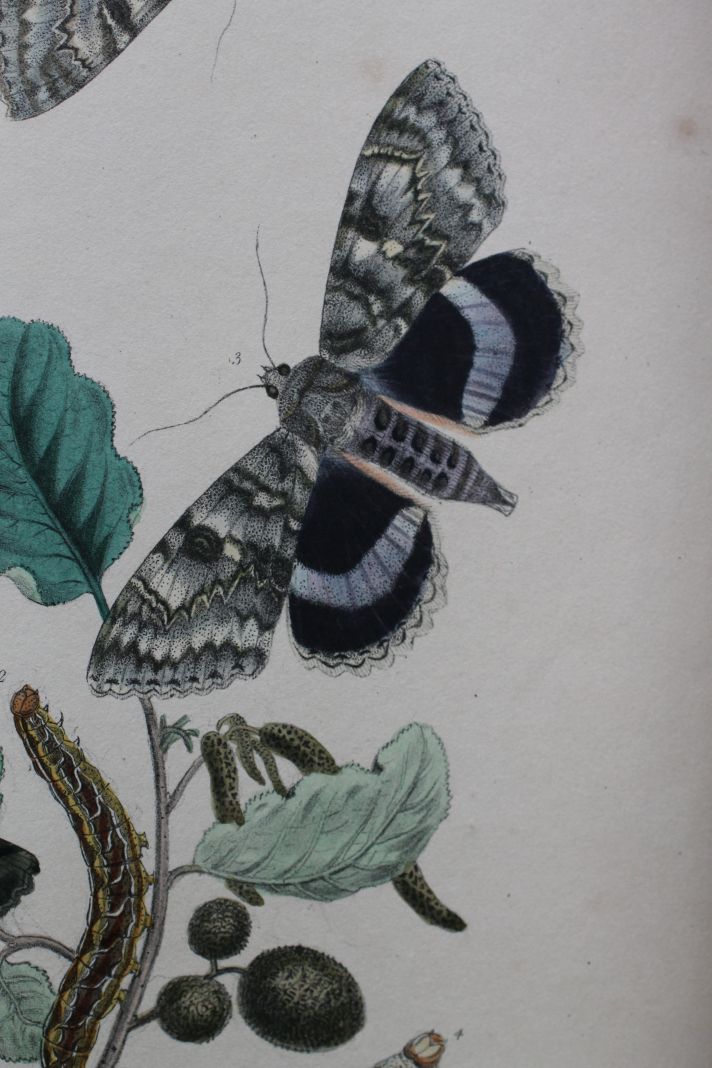
Below, as an extra for National Moth Night, is an image from Humphreys and Westwood's British Moths and their Transformations  pub. in 2 Vols by William Smith of London. 1843. It is a hand-coloured illustration of the recently re-introduced Clifden Nonpareil (Catocala fraxini).  The first half of the scientific name Catacola means 'beautiful beneath'; the second half is a reference to the ash tree (Fraxinus excelsior) which Linneaus (wrongly) thought was the food plant.


Clifden Nonpareil (Catocala fraxini)


1 October 2012 - Poor Jenny Wren

Green-brindled Crescent (Allophyes oxyacanthae ab capucina)
The Green-brindled Crescent has flown this way before but only in its 'typical' form, with metallic shards of green decorating the fore-wing.  This plainer, browner version (ab capucina) takes its name from the Latin 'cappa' meaning a cap.  The French word 'capuce' - a pointed hood or cowl gave the name of Capuchin to the monks of the Franciscan order.  All because of that prominent crest that can be seen in the photograph.
There was only one other moth in the trap - and a dead wren.  This causes concern and I hope it will not happen again.  Wrens lurk around the trap and will occasionally pursue a carpet moth into the undergrowth but this is the first time one has flown into the light-trap and been unable to find its way out. 

10 October 2018 - The Marvel of the Day

Merveille du Jour (Dichonia aprilina)

Out walking near Adel last night, without a coat, I noticed the relative warmth of the evening was causing some fluttering among the shrubs and bushes that line the main road - the Otley Road.  There were lights everywhere - overhead street lamps, upstairs and downstairs bed and dining  rooms, garages, shops and the headlights of passing traffic.  Through this light-saturated habitat the moths of Adel were still managing to cling on to life.  In the Quaker graveyard, set back from the road and comparatively dark, there were quite a few whirring about their business.  When I arrived back in Coxwold the trap was brought out and some of the results can be seen here.  

The Merveille du Jour (Dichonia aprilina) is not common in North Yorkshire but we get one or two every year - just as the apples are falling.  An account of the derivation of the moth's scientific name can be seen if you type 'merveille' into the search box - or click to take you here.
Without a doubt it is a startling moth.  This one was pushing its proboscis through the fine mesh of the moth cage in search of the ivy flower or ripe berry.

Red-green Carpet (Chloroclysta siterata)

Another moth that carries a rich, crunchy green on its wings is the Red-green Carpet (Chloroclysta siterata). In the photograph above the redness is not clearly shown but this moth is variable and any presence of what is described as a 'marbled reddish brown' will be sufficient to confirm its identity.  The female overwinters and the larvae feed on broadleaved trees as well as apple and rowan.

Green-brindled Crescent (Allophyes oxyacanthae)

The third green moth is another Green-brindled Crescent - number two on the Yorkshire Moths Flying Tonight list.  This is the season for this moth and the photograph shows the paler version - the darker was seen a week or so ago. This moth is found throughout the country and is described as 'abundant'. I have included it once again as it represents so many of the moths in this country - hardly seen at all, beautifully marked and so fragile.

Brown Plume (Stenoptilia pterodactyla)
The final image is that of the Brown Plume (Stenoptilia pterodactyla).  I love the Plume moths but hardly ever see them.  This one I found imprisoned in the gallery, clinging to a window pane and it was a pleasure to release it into the garden.  What a strange and ethereal moth it is.  See an earlier description and derivation of the scientific name here.

14 October 2017 - Moth and Sympathetic Magic

Green-brindled Crescent (Allophyes oxyacanthae)
Fortunately I was reminded that it was National Moth Night.  The mercury vapour light was switched on around 8pm and a few moths appeared immediately.  The trap was positioned close to the clumps of ivy in the walled garden as the recently flowered climber has been visited by lots of Red Admiral butterflies over the last couple of weeks.  Ivy seems to provide one of the last sources of nourishment for insects as the year fades.

The first moth to be recognised in the trap this morning was the Green-brindled Crescent.  The scientific name refers to the food plant (hawthorn - Crataegus oxyacantha) and to the Greek allophues - 'changeful in nature'.  It is a common moth and easily recognisable but the amount of green colouring present varies considerably.  The one above has a splatter of colour where the wings meet over the thorax.


Feathered Thorn (Colotois pennaria)
The Feathered Thorn - the moth with the 'stunted ears' - seems to have found the perfect leaf upon which to settle.  The scientific name is open to interpretation as it might be a typographical error.  The distinguished German entomologist Hubner believed that the name could have been Calotois (beautiful ear) rather than Colotois (stunted ear).  The fact that the moth doesn't have ears makes it all rather confusing; pennaria from the Latin penna refers to the feather-like antenna

Yellow-line Quaker (Agrochola macilenta)
The Yellow-line Quaker is another familiar visitor although the one pictured above is paler than usual.  The caterpillar feeds on oak and beech - further north it adds heather to its diet.
It's a busy little moth, easily disturbed and keen to hide from the daylight.

Sallow (Xanthia icteritia)
There are a number of Sallow moths and this one is the Sallow itself - Xanthia icteritia.  The name is particularly interesting as it seems to tap in to an ancient understanding of sympathetic magic.  Icterata is the Latin for jaundice and the Icterus was a yellow bird that, if caught sight of, would cure the malady.  If the cure was successful the bird itself would die.
(On the south doorway of Alne church in North Yorkshire can be seen carved a Caladrius, a remarkable bird that can also take away sickness from the afflicted.) 

Pale Tussock Moth (Calliteara pudibunda) cocoon
Two extra images of a mothy nature.  This large bundle of silk was found by Chris on the back of one of the garden notices.  I had a hunch it might be Tussock moth and a quick check confirms the fact.  I have seen the spectacular Pale Tussock moth caterpillars on two occasions at Shandy Hall, both in the same location - beneath the sycamore next to the gallery steps.  This one will be left in peace and hopefully the hatching will be seen next year.

Autumn caterpillar
As for this tiny creature....